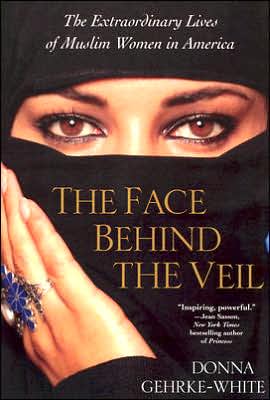
 Title: The Face Behind the Veil: The Extraordinary Lives of Muslim Women in America
Author: Donna Gehrke-White
Pages: 299
Rating: B
The Face Behind the Veil: The Extraordinary Lives of Muslim Women in America gives us a glimpse of the everyday lives of American Muslim women from all walks of life. The stories of African-Americans, white suburban housemoms, refugees, career-driven professionals, community activists, and others form the basis of this book with a series of 50 essays interviewing 50 different women.
In theory, this is a great book. It celebrates the initiatives many Muslim women (singular: Muslimah) have taken to stay true to their faith, many times in the face of adversity. We learn about women who are working for reform within Islam to allow men and women to pray side by side at the mosque; women that stand strong in their efforts to foster tolerance and understanding between different faiths and cultures; women who found peace and happiness in converting, and women who had the strength to leave everything behind in order to survive. Their stories are touching, and poignant.
Yet, there is a lot I did not like about this book, which I view as mainly a weakness on the author's part. My main criticisms:
1. The author included stories about 50 women in a book that is just under 300 pages. That is an average of 6 pgs/person. I felt that many of the stories were very superficially researched. I believe more justice could have been done to this topic by focusing more intensively and analytically on a smaller number of case studies. Furthermore, this "skimming the surface" approach opens the book up to criticism, especially when so many of the stories involve negative situations.
2. This book is about a celebration of Muslim women. I am confused as to why the author chose to include a chapter on a woman who was Christian, converted to Islam, then became a born-again Christian and a minister. She blamed her domestic violence situation on Islam, and, as a Christian minister, has started a non-profit to help Muslim women. Her story is no less important and valid, but I think it detracts from the purpose of this book.
3. In the section on "The Persecuted", there was only one story of an African Muslim refugee. Yet, the largest numbers of refugees currently admitted to the US are from Africa, and many are Muslim.
4. You are a journalist! You have an editor! Yet, the number of grammatical mistakes I found were astounding, and I wasn't even looking for them!
With all of that said, the profound and inspiring stories of the women interviewed still manage to shine through, which is why I still gave this book a fairly decent rating. It shows the positive power of diversity.
In some ways, this book is similar to a non-fiction book idea I am currently doing some preliminary research on, that of the experiences of refugee women in America. No one yet has turned my specific idea into a book, but I probably better speed up my plan!
In my new habit of tying other aspects of my life into the book that I am reading, I made a favorite recipe of mine, that was given to me by a good friend who is a Muslim woman from Kuwait.
Lebanese Mashed Potatoes with Meat (I don't know the real name for this):
4 lg potatos, boiled
2 T butter
1/2 cup milk
1 tsp salt
Filling:
1 onion, chopped
1/2 lb lamb meat
Lebanese spice mix (Baharat: composed of black pepper, paprika, cumin, coriander, cloves, nutmeg, cinnamon, and cardamon)
1/4 cup pine nuts
1 small can mushrooms, chopped
1 tsp salt
1 tsp allspice
Topping:
2 T butter, cut in small pieces
Bread crumbs
Mash potatoes with butter, salt, and milk. Prepare filling. Fry meat with Baharat spice mix. Add onions and fry till golden brown. Add pine nuts and mushrooms, fry well. Spread 1/2 of potato mixture in the bottom of a greased pan. Add in the filling, and cover with the rest of the potato mixure. Dot with butter and sprinkle with bread crumbs. Bake at 250F for 25 min. Cut in squares, serve, enjoy!