Showing posts with label summer poetry challenge; poems. Show all posts

Wednesday, August 15, 2007

Pilgrimage - Natasha Trethewey

Here is a much delayed, final entry in the Summer Poetry Reading Challenge.

Natasha Trethewey received the Pulitzer Prize for Poetry this year for Native Guard. The following poem, 'Pilgrimage' is one selection from this book. I definitely plan on reading the whole book sometime; her poetry is engaging, and the imagery is profound as she chronicles part of the history of the South, especially the Native Guard, one of the southern black regiments engaged in the Civil War.

Here, the Mississippi carved
its mud-dark path, a graveyard


for skeletons of sunken riverboats.
Here, the river changed its course,

turning away from the city
as one turns, forgetting, from the past—

the abandoned bluffs, land sloping up
above the river's bend—where now

the Yazoo fills the Mississippi's empty bed.
Here, the dead stand up in stone, white

marble, on Confederate Avenue. I stand
on ground once hollowed by a web of caves;

they must have seemed like catacombs,
in 1863, to the woman sitting in her parlor,

candlelit, underground. I can see her
listening to shells explode, writing herself

into history, asking what is to become
of all the living things in this place?

This whole city is a grave. Every spring—
Pilgrimage—the living come to mingle

with the dead, brush against their cold shoulders
in the long hallways, listen all night

to their silence and indifference, relive
their dying on the green battlefield.

At the museum, we marvel at their clothes—
preserved under glass—so much smaller

than our own, as if those who wore them
were only children. We sleep in their beds,

the old mansions hunkered on the bluffs, draped
in flowers—funereal—a blur

of petals against the river's gray.
The brochure in my room calls this

living history. The brass plate on the door reads
Prissy's Room. A window frames

the river's crawl toward the Gulf. In my dream,
the ghost of history lies down beside me,

rolls over, pins me beneath a heavy arm.

Tuesday, August 7, 2007

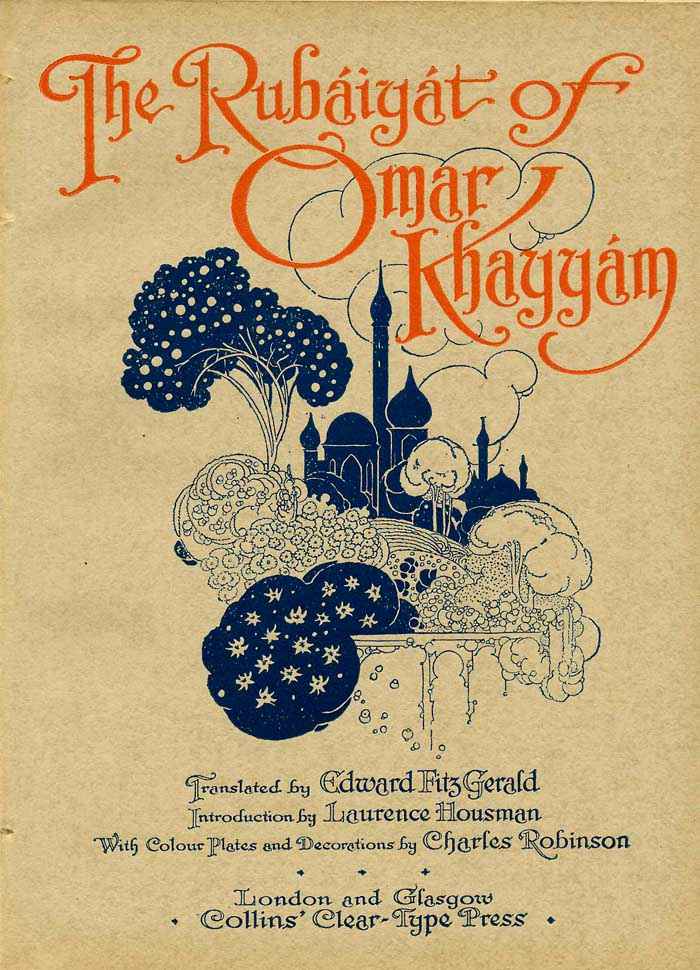
The Rubaiyat of Omar Khayyam


My third post in the Summer Poetry Challenge is about Edward Fitzgerald's interpretation of 12th century's Omar Khayyam's Rubaiyat, which became one of the most widely read poems of the 19th century. However, it is not considered to be a literal translation of the original, as Fitzgerald took a many liberties in his interpretation, in order to make a beautifully styled English version. Despite this, many scholars still consider Fitzgerald's version to be faithful to Omar's original meaning.

It would take years to begin to understand the metaphorical, intrinsic meanings of the quatrains. On the surface, The Rubaiyat seems to encourage living your life fully each day. It is impossible to understand the world around you, so live life to its fullest. There also seems to be a focus on the importance of friendship, and the delights of the tavern. I know, very profound. :)

Here are a few of my favorite quatrains:

I
Awake! for Morning in the Bowl of Night

Has flung the Stone that puts the Stars to Flight:
And Lo! the Hunter of the East has caught
The Sultán's Turret in a Noose of Light.

II
Dreaming when Dawn's Left Hand was in the Sky
I heard a Voice within the Tavern cry,"
Awake, my Little ones, and fill the Cup"
Before Life's Liquor in its Cup be dry."

XX
Ah, my Beloved, fill the Cup that clears
TO-DAY of past Regrets and future Fears:
To-morrow! Why, To-morrow I may be
Myself with Yesterday's Sev'n thousand Years.

XXI
Lo! some we loved, the loveliest and best
That Time and Fate of all their Vintage prest,
Have drunk their Cup a Round or two before,
And one by one crept silently to Rest.

XXII
And we, that now make merry in the Room
They left, and Summer dresses in new Bloom,
Ourselves must we beneath the Couch of Earth
Descend, ourselves to make a Couch--for whom?

XXIII
Ah, make the most of what we yet may spend,
Before we too into the Dust descend;
Dust into Dust, and under Dust, to lie,
Sans Wine, sans Song, sans Singer, and--sans End!

XXXI
Up from Earth's Centre through the Seventh Gate
I rose, and on the Throne of Saturn sate,
And many Knots unravel'd by the Road;
But not the Knot of Human Death and Fate.

XXXII
There was a Door to which I found no Key:
There was a Veil past which I could not see:
Some little Talk awhile of ME and THEE;
There seem'd--and then no more of THEE, and ME.

Thursday, August 2, 2007

Her Kind - Anne Sexton

This is my second post for the Summer Poetry Challenge.


'Her Kind'
, by Anne Sexton, published in 1960, is a deeply personal poem. It is written in first person, yet Anne compares herself to the female subject of the poem. 'A woman like that is misunderstood. I have been her kind.' Irregardless, this poem delves deep into her psyche, and is the portrayal of the multiple nature of human personalities. I think the poem is also telling of the stereotypes women faced (and continue to face) in a male-dominated society. It is a deeply mysterious poem, one that can produce hundreds of interpretations. Below is what it means to me.

The poem illustrates three personas: witch, housewife, and martyr, all personified in the theme of a woman being burned at the stake. The first stanza Anne describes the subject as a possessed witch:

I have gone out, a posessed witch,
haunting the black air, braver at night;
dreaming evil, I have done my hitch
over the plain houses, light by light:
lonely thing, twelve-fingered, out of my mind.

A woman like that is not a woman, quite.
I have been her kind.
Using the metaphor of the traditional image of witch, Anne is describing the ways in which she does not fit the caricature of the 1950's/60's ideal woman. She dreams evil; is more comfortable in herself in the dark of night rather than the well-lit homes of the suburbs. She is twelve-fingered, different from others in ways that she feels are obvious.

The second stanza, Anne embodies the traditional witch image with that of the housewife:
I have found the warm caves in the woods,
filled them with skillets, carving, shelves,
closets, silks, innumerable goods;
fixed the suppers for the worms and the elves:
whining, rearranging the disaligned.
A woman like that is misunderstood.
I have been her kind.
She uses the imagery of a housewife, with components that seem out of place to this image, such as 'fixing the suppers for worms and elves'. Anne has tried to fill this role: marrying, having kids, living the life of a suburban housewife. Through this experiences she has learned how women are pigeon-holed into this life in order to be accepted by society. Many women in this role are unhappy, and misunderstood, like she was herself.

The third stanza is the persona of the martyr, and she goes back to the historical time when women were burned at the stake if found to be a witch:
I have ridden in your car, driver,
waved my nude arms at villages going by,
learning the last bright routes, survivor
where your flames still bite my thigh
and my ribs crack where your wheels wind.
A woman like that is not afraid to die.
I have been her kind.
I feel this last stanza illustrates the most self-empowering of all three. She has come to accept that her lifestyle is different from society, and in essence is thumbing her nose at everyone else, saying she does not care what they think. She is finally true to herself. Despite the approach of death, she is setting an example of empowerment by defying the roles conscripted to herself and other women, and that is what matters most.

Monday, July 30, 2007

The Mouse and the Camel - Rumi

This is my first post for the Summer Poetry Challenge, hosted by Bookeywookey. I read poetry very rarely, and don't profess to any great insights on the poetry I have selected. This challenge did appeal to me as a possible kick-start to reintroduce poetry into my life, a genre that is neglected by many.
My choice of poems prior to the 1900's is 'The Mouse and the Camel' by Rumi, originally found in Rumi's most well known work, Masnavi.

About Rumi: Rumi, was born on September 30, 1207 as Jelaluddin Balkhi in Balkh, Afghanistan, which was then part of the Persian empire. Between 1215 and 1220, he and his family fled the threat of invading Mongols and emigrated to Konya Turkey; it was sometime after this that he became known as Rumi (meaning from Roman Anatolia). His father was a theologian and mystic, and after his death Rumi took over the role of sheikh in Konya's dervish community. After meeting a wandering dervish, Shams of Tabriz, Rumi became enveloped in a world of mystical conversation. Sham became one of the most profound influences in Rumi's life. Near the end of his life, Rumi focused on his greatest achievement, Masnavi. After twelve years of work on this masterpiece, Rumi died in 1273.
THE MOUSE AND THE CAMEL

The Mouse and the Camel begins in a style that reminds me of Aesop's fables.

A mouse caught hold of a camel’s lead rope
in his two forelegs and walked off with it,
imitating the camel drivers.

The camel went along,
letting the mouse feel heroic.

“Enjoy yourself,”
he thought. “I have something to teach you, presently.”

The came to the edge of a great river.
The mouse was dumbfounded.

“What are you waiting for?
Step forward into the river. You are my leader.
Don’t stop here.”

”I’m afraid of being drowned.”

The camel walked into the water. “It’s only
just above the knee.”

Your knee! Your knee
is a hundred times over my head!”

Well, maybe you shouldn’t
be leading a camel. Stay with those like yourself.
A mouse has nothing really to say to a camel.”

“Would you help me get across?”

“Get up on my hump. I am made to take hundreds like you across.”

You are not a prophet, but go humbly on the way of the prophets,
and you can arrive where they are. Don’t try to steer the boat.
Don’t open a shop by yourself. Listen. Keep silent.
You are not God’s mouthpiece. Try to be an ear,
and if you do speak, ask for explanations.

There is the boastful animal, the mouse, who is taught a lesson by another animal, the camel. In essence, the mouse bit off more than it could chew, confusing luck or coincidence--catching the camel's harness--with achievement. The camel reminds the mouse that imitating those more powerful than you can lead to great problems down the road. It strikes me as a warning against spiritual pride that still resonates today.
The source of your arrogance and anger is your lust
and the rootedness of that is in your habits.

Someone who makes a habit of eating clay
gets mad when you try to keep him from it.
Being a leader can also be a poisonous habit,
so that when someone questions your authority,
you think, "He's trying to take over."
You may respond courteously, but inside you rage.

Always check your inner state
with the lord of your heart.
Copper doesn't know it's copper,
until it's changed to gold.

Your loving doesn't know its majesty,
until it knows its helplessness.

These gifts from the Friend, a robe
of skin and veins, a teacher within,
wear them and become a school,
with a greater sheikh nearby.
In these stanzas Rumi continues with the moral of the story. I feel in these lines he is speaking directly to those who are spiritual leaders, the sheikhs and imams of his time. He reminds the reader that many spiritual leaders become so entrenched in their habit of authority, that they become deaf to sound advice, responding with jealousy, anger, and pride. I really love the last two lines, 'become a school, with a greater sheikh nearby.' I took that to mean that one should share your knowledge, but do not boast, and always continue to seek the wisdom of others with an open mind.

There is one stanza I continue to go back to, with the feeling that I should know what Rumi is saying, yet I don't. 'Always check your inner state with the lord of your heart. Copper doesn't know it's copper, until it's changed to gold.' What do you think this means?

Sunday, July 29, 2007

Summer Poetry Challenge

Summer Poetry Challenge
I managed to just join in on BookeyWookey's Summer Poetry Challenge just before the August 1st start date. This is a great excuse to spend some time with some wonderful poets, in a genre I neglect far too much.

For the challenge, you need to select four new-to-you poems, three from different time periods, and one poem from any time period that you find mysterious, intimidating, or just don't understand.

My selections are:
Before 1900: 'The Mouse and the Camel' by Rumi (13th century). It is originally from the Masnavi-I Ma'navi, but the translation I am using is from Rumi: Selected Poems, published by Penguin Classics.
Between 1900-2000: 'Her Kind' by Anne Sexton, from To Bedlam and Part Way Back (1960).
2000-2007: 'Pilgrimage' by Natasha Trethewey, from Native Guard: Poems (2006).
An intimidating poem: The 'Rubaiyat' of Omar Khayyam (12th century). The version I am reading is in the book A Treasury of Asian Literature; the poem is translated by Edward Fitzgerald.

And to start off the poetry fun, I would like to post my runner-up choice for the 2000-20007 category. This poem, Fishing on the Susquehanna in July by Billy Collins, caught my eye right away. Unlike the poet, I did grow up fishing on the Susquehanna River, which is 20 minutes from my home. I also camped by it, skipped rocks on it, and went water tubing and swimming in it. And, one of my fellow classmates was lost to this world when climbing a small span of cliffs bordering the river. Out of all the rivers in the world, it is probably the one that holds the most memories to me.
Fishing on the Susquehanna in July
-Billy Collins

I have never been fishing on the Susquehanna
or on any river for that matter
to be perfectly honest.

Not in July or any month
have I had the pleasure--if it is a pleasure--
of fishing on the Susquehanna.

I am more likely to be found
in a quiet room like this one--
a painting of a woman on the wall,

a bowl of tangerines on the table--
trying to manufacture the sensation
of fishing on the Susquehanna.

There is little doubt
that others have been fishing
on the Susquehanna,

rowing upstream in a wooden boat,
sliding the oars under the water
then raising them to drip in the light.

But the nearest I have ever come to
fishing on the Susquehanna
was one afternoon in a museum in Philadelphia

when I balanced a little egg of time
in front of a painting
in which that river curled around a bend

under a blue cloud-ruffled sky,
dense trees along the banks,
and a fellow with a red bandanna

sitting in a small, green
flat-bottom boat
holding the thin whip of a pole.

That is something I am unlikely
ever to do, I remember
saying to myself and the person next to me.

Then I blinked and moved on
to other American scenes
of haystacks, water whitening over rocks,

even one of a brown hare
who seemed so wired with alertness
I imagined him springing right out of the frame.

-from
Picnic, Lightening (1998)