Sunday, September 23, 2007

Book Memories Meme

I found this one at SMS Book Reviews.

20 Years Ago: (age 8)
I'm not sure what I was reading at age 8. I know I was reading chapter books by that age, probably along the lines of Charlotte's Web and definitely Ramona Quimby, Age 8. I also loved Pippi Longstocking.

10 Years Ago: (age 18)
This was just my last year of high school and the beginning of college. I read a lot that summer because I was ill with mono. Probably books by Stephen King and Dean Koontz. Lots of light fiction.

5 Years Ago: (age 23)
I was in the middle of writing my master's thesis, so I read a lot of non-fiction and current events books. In my spare time, I discovered Graham Greene and Janet Evanovich, and read more of Barbara Kingsolver.

3 Years ago: (age 25)
I started keeping track of the books I read in this year. Highlights include Agatha Christie mysteries, The Kite Runner, and novels by Australian authors Nick Earls and Tim Winton.

Last Year: (age 27)
I started the year strong on non-fiction with books about Frida Kahlo and Winterdance by Gary Paulsen (the latter was read on the plane to our honeymoon destination in Banff, Alberta, Canada. I revisited L.M. Montgomery's Anne of Avonlea series, and read quite a few award winners and shortlisted books.

This Month: (age 28)
This month I'm taking a break from pregnancy/breastfeeding/parenting books with The Hours, The Namesake, Human Cargo, and A Woman in Jerusalem.

3 Favorite Reading Locations:

My bed, the couch, our patio in the morning or evening.

3 Reading habits:
Reading every night before I fall asleep
Sometimes reading to put myself to sleep
Telling the nearest person about the interesting parts of a book as I read them. My husband *loves* me for this one!

3 Things that distract me:
Internet!
Our cat
The standards of pregnancy: an irrepressible bladder, fatigue, hunger.

3 Characters I’d love to be:
In another 40 years or so, I would love to be Agatha Christie's Miss Marple.

3 Characters I despise:
Cathy/Kate from East of Eden

3 Favorite Book Beverages:
Tea
Water
Wine

3 Favorite bookmarks:
I always pick up those free bookmarks found at bookstores, since I tend to lose bookmarks all the time. I have also been using the home-made bookmark that Bookfool at Bookfoolery and Babble sent me for being a runner up in the Chunkster Challenge drawing.

3 Dead Writers I’d love to meet:
Jane Austen
John Steinbeck
Virginia Woolf

3 Alive Writers I’d love to meet:
Margaret Atwood
Isabel Allende
Chinua Achebe

Non-Fiction Five Challenge Wrap-Up

One of my New Year's reading resolutions this year was to read more non-fiction. So, when Joy announced the start of a Non-fiction five challenge over at Thoughts of Joy, I enthusiastically jumped right in.

I managed to complete the challenge, but am still dismally behind in my goal of having 25% of my total books read in 2007 consist of non-fiction books. I'm currently at 18% with 11 books, a little bit better than last year.

A big thanks to Joy for hosting this challenge! It was great to see what other people were reading, and I have definitely added some more books to my TBR list through this challenge.

My finished challenge books are:

All but one of these books were on my original challenge list. I substituted The Birth Partner in for Birthing from Within, which was proving difficult to obtain from the library.

The best book: I liked most of these books. The Birth Partner probably ranks as my favorite, because out of all the pregnancy books I have read or skimmed, this by far seems to be the most helpful to me in preparing for an unmedicated, midwife-assisted birth. I also really enjoyed Human Cargo.
What book could I have done without: Nickel and Dimed was so-so. I don't necessasrily regret reading it, but it definitely did not live up to its hype.

Any new authors? Each of these authors are new to me!

What did you learn -- about anything -- through this challenge? This challenge helped to cement my newly-found desire to read more non-fiction. I have added quite a few non-fic books, on many different subjects, to my TBR list. What's up next, you ask? After finishing with some breastfeeding and parenting books (this pregnancy is really eating into my non-fiction reading!), I hope to check out Climbing the Mango Trees by Madhur Jaffrey; Marie Antoinette by Antonia Fraser; Blue Latitudes by Tony Horwitz; or The Colony by John Tayman.

Saturday, September 22, 2007

Human Cargo - Caroline Moorehead

Title: Human Cargo: A Journey Among Refugees
Author: Caroline Moorehead
Country: UK
Year: 2005
Rating: A
Pages: 397 pgs.

First sentence: One day a man in a country in Africa was arrested and accused of belonging to an illegal opposition group.

This is my last selection for the Non-fiction Five Challenge hosted by Joy at Thoughts of Joy!

It is a rarity to see a book published about refugees, and even fewer are geared towards the general public. Ever since I first heard about Human Cargo: A Journey Among Refugees, I couldn't wait to see what it held. What I found is a book interesting to both individuals who know very little about the immigration system, and those who work in the refugee field.

Although many personal accounts are included in the narrative, much of the book is an examination of the refugee protection system in various countries around the world. A large focus is on the process of being declared a refugee (although a refugee is always a refugee, it only becomes official when the UNHCR or country providing protection declares you as one), and the stories are of asylum seekers in the midst of this process (asylum seekers, or asylees in America, is the term used to describe a person whose application for protection is currently being determined). Caroline Moorehead presents facts that are concise and well-researched, while gently reminding the reader that we are talking about real people who are being treated inhumanely.

I was delighted to find a book largely about asylum seekers, since I have worked with many people in this stage of the refugee application process; it's about time their experiences after fleeing persecution are brought to light. Her argument mirrors the same stand that I took in my master's thesis on forced migration (and our sources also largely overlap, as we were apparently researching the same topic around the same time): that there is a lot of gray area in regards to the issues that cause people to flee their home, and there is not a clear-cut distinction between economic migrants and refugees. 'For him, the distinction between economic migrant and asylum seeker has little meaning, when people are driven to the margins by need: "Do people have to die in order to work? Something has to be wrong."' (p. 86)

The 1951 Refugee Convention, which gives the world its definition of a refugee, is outdated and needs to be changed. Moorehead also backs up my belief that came about through my work experience that the Australian government has introduced one of the most exclusionary immigration policies of any democracy (p.119). However, I was saddened, but not surprised, to see that many of the problems I witnessed in Australia and America (asylum seekers denied the right to work and support themselves, huge backlogs, difficulties with providing evidence and accessing interpreters, general feelings of aimlessness and depression) are found throughout the world, as countries make somewhat irrational distinctions between "good" refugees--those from communist countries, or those who wait in a fictional queue in a refugee camp--and "bad" refugees: asylum seekers.

The Other Lost Boys: Liberians living in limbo in Cairo:

"What these lost boys had seen and been forced to do is not something others cared to hear about." (p.10)

"What is happening in Cairo today is happening all over the world; as the funds are cut and the number of asylum seekers keeps on growing, as the West becomes more fearful and more isolated, those who man the gates in Cairo are under pressure to search ever more keenly for lies and inconsistencies, while refugees despair." (p.12)
One asylum seekers' despair:
"But who is to say what is credible when you have been shot at by rebels, when you have seen your mother raped and your brothers and sisters burnt to death in your house, when your father has disappeared and you are now alone in the world? When you are ashamed to describe to the young woman sitting across the desk from you with her tapping pencil and inquisitive eyes what the soldiers did to you and how you are afraid that you may have AIDS from being raped by the guards and how you ache for news of your family whom you really know perfectly well that you will never see again?"(p.23)

Thursday, September 20, 2007

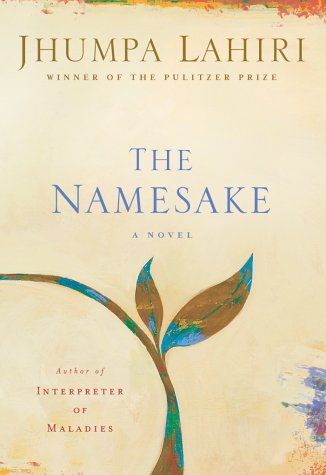
The Namesake - Jhumpa Lahiri

Title: The Namesake
Author: Jhumpa Lahiri
Country: America
Year: 2003
Rating: A-
Pages: 291 pgs.

First sentence: On a sticky August evening two weeks before her due date, Ashima Ganguli stands in the kitchen of a Central Square apartment, combining Rice Krispies and Planters peanuts and chopped red onion in a bowl.

The novel begins in 1968 with the birth of a boy named Gogol Ganguli. His mother, having recently emigrated to America after an arranged marriage to Ashoke, "is terrified to raise a child in a country where she is related to no one, where she knows so little, where life seems so tentative and spare." (p.6) Yet Gogol is born, and comes by his name through a series of random occurences. Despite the randomness of his naming, it is a name that holds personal meaning for his father Ashoke.

The family, soon to include a daughter Sonia, slowly find their way, balancing the old and the new. The Namesake is not only a coming-of-age story; it is a family portrait of a Bengali couple raising their children in a new culture. Lahiri adeptly captures the disparities between parents who view their country of origin as home, but raise American children who abandon their ethnic identity and squirm in discomfort on each visit 'home' to Calcutta. Although the story centers around Gogol and his search to become reconciled with his identity, we follow each family member as they search out their own path. I would definitely recommend this story of individual growth amidst family (and cultural) relationships.

Wednesday, September 19, 2007

New Books!

We just returned from a relaxing, albeit hot, vacation/visit with hubby's family in the Phoenix, AZ area. The temperatures barely dipped below 100 and were more frequently between 105-110. Needless to say my 32-week pregnant self spent a large amount of time in the pool!

I always return from visits with my in-laws with new books; they generously pass on paperbacks they have already read. Here are my latest acquisitions:

1. The Robber Bride - Margaret Atwood
SIGNED!!! After finding out that Margaret Atwood is one of my favorite authors, my father-in-law completely surprised me by giving me his signed copy of The Robber Bride. Woohoo!!! This book is added to my small, prized collection shelf.
2. The Egyptologist - Arthur Philips
3. The News from Paraguay - Lily Tuck
This one won the National Book Award but only averages 2 stars on Amazon. My in-laws liked it, I look forward to finding out for myself how it is.
4. The Great World - David Malouf
5. The Winter Queen - Boris Akunin
This is the first book in a historical mystery series that is very well known in Russia.
6. Seven Types of Ambiguity - Elliot Perlman
7. The Peppered Moth - Margaret Drabble


The little monkey is one of the gifts we received at the baby shower that was given for us. This little guy, a Miyim organic monkey (no pretensions here, he's as natural as can be), also happens to be a book lover! Until Maya is old enough to name him, we shall call him Darwin.

The Hours - Michael Cunningham

Title: The Hours
Author: Michael Cunningham
Country: America
Year: 1998
Rating: B-
Pages: 230 pgs.

UPDATE:
This is turning out to be one of the novels that, for me, is enhanced by time. I watched the movie while on vacation, and believe the two complement each other wonderfully. After absorbing and thinking about Michael Cunningham's style, I've changed my mind, and now have a higher opinion of this book.

First sentence: She hurries from the house, wearing a coat too heavy for the weather.

Passionate, profound, and deeply moving. That is the description found on the back cover of my copy of The Hours. That statement places a large expectation in the mind of the reader. Does the novel live up to it? In some ways, yes. In others, no.

Michael Cunningham pays homage to Virginia Woolf in this novel about three women (including Virginia Woolf herself) from three different generations who are tied together by Woolf's novel Mrs Dalloway. Writing in a style reminiscent, but not quite as good, as Woolf herself, Cunningham takes you on a day's journey in the lives of these three women, as we see how their stories intertwine.

I felt the largest weakness of the novel was the one-dimensional aspect of the women, particularly Laura Brown and Clarissa. I was particularly disappointed with the imitative style of Clarissa's storyline. I was expecting something more out of a Pulitzer winning book.

Would I recommend The Hours to others? Maybe. I don't feel as if I wasted my time reading it. The quality of writing is superb, and for that alone, I feel it was worth the read. And I really enjoyed the symbolism he incorporates, particularly with roses. But it might not stick around on my bookshelf that much longer (keep an eye on my PBS account if you would like the book--it will probably end up there soon).

Monday, September 10, 2007

Friday, September 7, 2007

The Booker Short List has arrived


The Booker judges announced in London yesterday that they have laid another egg, and have come to a decision on the shortlist.

The six short-listed books are:

  • Darkmans by Nicola Barker
  • The Gathering by Anne Enright
  • The Reluctant Fundamentalist by Mohsin Hamid
  • Mister Pip by Lloyd Jones
  • On Chesil Beach by Ian McEwan
  • Animal's People by Indra Sinha
And for those who did not see the Chair's blog entry after the announcement of the long list, you don't want to miss this metaphor:

The atmosphere in the judging room was somewhere between a book club and a maternity ward. What could be more agreeable than a freeform discussion of 110 novels, when you know that everyone else in the room has read them all and - even better - is obliged to display at least a polite interest in your exciting views? The only fly in the conversational ointment is that you are under the cosh to deliver 13 favourites at the end of it all.

Around five o'clock we gave birth, with Ion Trewin as an unlikely bearded midwife.

Sunday, September 2, 2007

Saturday's Six

I might start to make this a regular thing...I haven't decided yet.

1. Twelve percent of Americans say they have never had someone of a different race in their home. Have you had someone of a different race in your home? Have you been in the home of someone of a different race?

I have honestly never even thought about that. But yes, I have. Many, many times.

2. When asked if they think gay people are actually born gay (as opposed to “choosing” to be gay, 51% say that homosexuality is something one is born with. Do you agree?

I believe there can be a genetic component. But most people don't ask if you think individuals are born straight, so why are ask if people are born gay?

3. Given our society’s obsession with the “perfect body,” the number might be expected to be higher, but 33% of Americans say they’d leave their partner if he or she gained 100 pounds. Would you?

No. But I would really worry about his health, especially since cholesterol problems run in his family. And if that weight was gained in a relatively short period of time, I would be really concerned.

4. This question was originally asked only of women, and 54% said they’d prefer to watch the Super Bowl over the Academy Awards. Which would you pick and why?

The Academy Awards. I watch tennis, soccer, and occasionally basketball, but I have never been a football fan. When I go to Super Bowl parties, I don't spend very much time watching the game. On the other hand, I love movies.

5. We hear a lot these days about protecting the institution of marriage. Oddly enough, that phrase is generally used in efforts to prevent people who love each other and want a committed relationship from actually getting married. Fifty percent of Americans say that it would be a good idea to require couples eligible for marriage to undergo marriage counseling before they can walk down the aisle. Is this a good idea or a bad idea?

There are many churches that require premarital counseling before they will perform a wedding. I don't think this is the solution for lowering the divorce rate.

6. A popular potato chip’s ad slogan says, “Once you pop, you can’t stop.” But 39% of Americans claim that they can stop at just one chip. Are you one of them?

One chip? I don't eat chips very often, but when I do, I don't think I could have just one. I usually eat them to satisfy a salt craving and one chip just isn't going to cut it. One serving, maybe.

BookPage Inspired Desires

I picked up the August edition of Bookpage at the library this weekend, and there were quite a few books that caught my interest. And thank you to Dewey at the hidden side of a leaf for the inspiration in how I formatted this post.
Strawberry Fields by Marina Lewycka. Marina's first book, A Short History of Tractors in Ukrainian, fits the rare category of books that have made me laugh out loud in public. It was a delight to read, so I'm looking forward to checking out her latest, a dark, comic trip through rural England as told by migrant workers on a strawberry farm.

Consumption by Kevin Patterson. A young Inuit woman returns to her home at Rankin Inlet after spending sex years at a sanatorium recuperating from tuberculosis.

Travel Scrapbooks: Creating Albums of Your Trips and Adventures by Memory Makers Books. The photos and mementos from my four months travelling the world reside in a large box. Photos from our trips to New Zealand, Fiji, and our time in Australia live on the computer. Therefore, this book might come in handy.

God Is Dead by Ron Currie Jr. In this dystopian novel, God descends to Earth as a Dinka woman from Sudan and is murdered in Darfur. This sets the scene for the rest of the novel, short-story like chapters that reveal what happens in a post-God world. This debut novel sounds very Orwellian, and has certainly captured my eye.

Slummy Mummy by Fiona Neill. I saw this novel mentioned in Newsweek not too long ago in an article about the media focus of the 'tension' between working moms and stay-at-home moms. It's a story that chronicles the life of one not-so-organized SAHM mother of three.

A Woman in Jerusalem by A.B. Yehoshua. This NYT notable is already on my TBR list, but unfortunately my library does not have a copy.