Showing posts with label bookworms read. Show all posts

Tuesday, July 31, 2007

Cat's Eye - Margaret Atwood
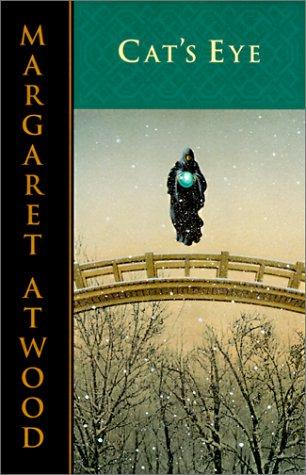
Title: Cat's Eye
Author: Margaret Atwood
Country: Canada
Year: 1988
Rating: A-
Pages: 462 pgs.

First sentence: Time is not a line but a dimension, like the dimensions of space.

In the winter, I dream of sandy beaches and lemonade. In the summer, it's that first snowstorm and hot apple cider. So there was nothing better to read about on a humid July day in the middle of a never-ending heat wave than a girl growing up in the cold, Canadian winters. I was delighted at the talk of snowpants, mittens, and wool caps; snow angels; and snowball fights. For much of Cat's Eye was a retrospective look into the post-WWII childhood of the central character, Elaine Risley.

Cat's Eye is the story of Elaine Risley, who returns to Toronto after a long absence, for a retrospective of her art. Her story is split into past and present, as Elaine yearns to reconcile her memories with the woman she has become.

Margaret Atwood is known for her varied story-telling, but Cat's Eye continues an exploration that is common to her work: a not-to-strong central female character, who is delving into her past, in an attempt to understand her present place in this world. Elaine's story is imbued with Atwood's critical and thoughtful statement of childhood, examining the turmoil and strife that accompanies girls as they grow up--especially what they do to each other.

One thing that always draws me to Margaret Atwood's novels is her vivid characterizations, and this story is no exception. At the end, I feel like I know Elaine, Elaine's mother and father, her best friend Cordelia, and many of the other women in the novel. I am always sad to turn the last page, to be at the end. Which is why I always come back to her books for seconds. It's like greeting an old friend.

'My brother and I stand at the end of a ramshackle dock beside a long blue craggy lake. It's evening, with a melon-coloured sunset, loons calling in the distance, the drawn-out rising note that sounds like wolves.' (p. 71)

'Most mothers worry when their daughters reach adolescence, but I was the opposite. I relaxed, I sighed with relief. Little girls are cute and small only to adults. To one another they are not cute. They are life-sized.' (p. 129)

' "What's with her?" says the painter.
"She's mad because she's a woman." Jon says. This is something I haven't heard for years, not since high school. Once it was a shaming thing to say, and crushing to have it said about you, by a man. It implied oddness, deformity, sexual malfunction.
I go to the living room doorway. "I'm not mad because I'm a woman," I say. "I'm mad because you're an asshole." (p.377)

Friday, June 1, 2007

In Her Shoes - Jennifer Weiner

Title: In Her Shoes
Author: Jennifer Weiner
Year: 2002
Rating: A-
Pages: 424pgs


In Her Shoes was a quirky, fun read. I usually pick up "chick-lit" books as a break from a really tough, invigorating read. This time, it was a follow-up to Foucault's Pendulum.

I have to say I like Jennifer Weiner's writing, and her characters, much better than the last chick-lit books I read; the Shopaholic books by Sophie Kinsella. Basically, it's the story of two sisters. Rose is a 30 year-old attorney who is troubled by her physical appearance but has great taste in shoes. Maggie is Rose's younger sister, a gorgeous woman who struggles to overcome the challenges of dyslexia, and living in the shadow of her sister's success.

The story may sound trivial, but Jennifer Weiner does a great job of uncovering the deeper aspects to the story: self-esteem and body image; growth and empowerment; reconciliation; and family relationships. And I absolutely loved the parts of the novel from their grandmother's perspective at Golden Acres retirement community. Mrs Lefkowitz, the elderly lady that Ella (Rose and Maggie's estranged grandmother) assists, is a riot! I loved her!

A few gems:

Lewis, asking Ella out on a date for the first time,
Come on, old man! he told himself. He's been in a war; he'd buried a wife; he'd watch his son become a Republican with a Rush Limbaugh bumper sticker on the back of his minivan. He'd survived worse things than this. "Would you like to have dinner with me?" (p77)

Mrs Lefkowitz,
Mrs. Lefkowitz nodded. "He's a good one. Reminds me of my first husband." Ella was puzzled. "Your first husband? Did you have two?" Plant, sigh, stomp, shuffle. "Oh, no. I just call Leonard my first husband. It makes me sound more worldly."

Saturday, May 5, 2007

Fall On Your Knees

Title: Fall On Your Knees
Author: Ann-Marie MacDonald
Country: Canada
Year: 1996
Rating: A
Pages: 508pgs

Amazon describes Fall On Your Knees as a sprawling saga, which I feel is the perfect description for this novel about love, loss, religious fanaticism, guilt, redemption, race and class differences, abuse, and guilt...just to name a few. The reader is quickly captured and enthralled by the Piper family, and despite the emotional landslides and despair that surrounds virtually all of the characters, FOYK remains a page-turner to the very end.

Every character has their own secret, which leads to the further unraveling of the family over time. Materia, the child-bride married to James, lives a life of regret, and struggles to love her first-born child. James constantly struggles to reign in an inner demon: his journey is one that is deeply real and haunting all at once. Their children, each taking a special place in the family, are consumed and affected by the struggles of their parents. It is a story that is filled with darkness and sadness, yet is also humorous and loving. It is no easy feat to pull off such a story, and Ann-Marie MacDonald did an amazing job, especially when you consider the first line of the story: 'They are all dead now.'

The beginning of a secret:
'Everyone agrees to this fiction, and the only people who'd breathe a word of the actual facts to the the illegitimate child are those who are so malicious to begin with that they are easily dismissed as liars. As in truth they are. For the beneficent lie tells the truth about the child, which is "you belong to this community," whereas the malicious truthtellers use fact to convey a lie, which is "you don't belong." This is an imperfect system but it's the prevailing one. And as the years go by the facts get eroded and scattered by time, until there are more people who don't know than people who do.'

A Cape Breton sunset:
'This is the best of summer. Not yet eight in the evening, the sun has brought out the green of the ocean and bathed the sky in a soothing balm of fire. Days like this are so precious. Frances stops and looks out at the sea, which trembles at the caress of the sun.'

Saturday, February 10, 2007

Water for Elephants by Sara Gruen

Title: Water for Elephants
Author: Sara Gruen
Rating: A-
Pages: 335

Jacob Jankowsi is ninety. Or ninety-three. He has lived a fulfilling life, yet is plagued by someone else's secret. Her secret is the story of this novel, told from Jacob's perspective. At the age of twenty-three, after the tragic death of his parents, Jacob flees veterinary school at Cornell and hops aboard the train of the Benzini Brothers Most Spectacular Show on Earth. Hired to care for the animals, such begins a story of a varied group of people and animals, trying to make their way through the height of the Great Depression. Being kicked off the show means certain homelessness, and possible starvation.

Jacob meets a variety of characters that make the novel such a treat: Walter and Queenie, a dwarf clown performer and his dog; Marlena, one of the star performers; Camel, a baggage stock bloke who has run into some bad luck; Rosie, a loyal elephant and loving to those who treat her right; Rex the toothless lion, and many many more.

The story flows back and forth between the young 1920's Jacob and the present-day, cantankerous and feisty Old Jacob. Sara Gruen does a wonderful job of whisking you away to the world of the circus in the 1920's, and her meticulous research shines through. The animals really make this story, which is why the scenes of neglect become so heart-wrenching (especially if you are like moi, an animal lover). The ending was absolutely perfect, which ends in the present day with Old Jacob, but that's all I'm going to say.

More than anything, this story resurfaced my unfulfilled wish of being able to go back and time and talk to my grandmother about her life. After severe bouts of depression and numerous ECT treatments (when ECT was still very problematic), by grandmother was unable to recover many of her memories. Which also brings me to one of the few minor discrepancies in the novel. My grandmother was diagnosed as bipolar, which she was not (she did have major depressive disorder-the most common mental illness among elderly). August, the equestrian director and Marlena's husband, is described as paranoid schizophrenic. Yet, the term "schizophrenia" only began to be used after 1911, and the subset "paranoid schizophrenia" appeared officially in the DSM III in the 1980's. Small detail, as August very well could have been paranoid schizophrenic, but I'm highly doubtful that the circus manager would have known that in the 1920's. And now I'll push my psychology education back into its little compartment now. :)

My favorite quotes:
"I don't talk much about those days. Never did. I don't know why--I worked on circuses for nearly seven years, and if that isn't fodder for conversation, I don't know what is.
Actually, I do know why: I never trusted myself. I was afraid I'd let it slip. I knew how important it was to keep her secret, and keep it I did--for the rest of her life, and beyond. In seventy years, I've never told a blessed soul."

"The memory of last night htis me like a wrecking ball. I squeeze my eyes shut, trying to force my mind to go blank, but it won't. The more distressing the memory, the more persistent its presence."

"Walter and Camel spend the night making the noises men make when they're trying not to cry, and I spend the night punching my pillow up around my ears trying not to hear them."

"August marches off. I turn back to Rosie. She stares at me, a look of unspeakable sadness on her face. Her amber eyes are filled with tears."

Wednesday, January 3, 2007

Vanishing Acts - Jodi Picoult


Vanishing Acts - Jodi Picoult (C)
Not that impressed. Earlier today, I put the book down, fed up with it. To me it felt like a tired story line, with the same pattern as the other to Picoult books I have read. A woman, supposedly content and happy, suddently finds her life turned up side down. She was kidnapped at a young age, and never knew. I feel that I have read this plot dozens of times--unfortunately I can't remember the titles of any of those books. I picked it up again after dinner, skimming the rest of the story.

I like Jodi Picoult. She's not amazing, but My Sister's Keeper and The Pact were good. However, I don't know if I will be able to read anymore of her books. I tire quickly of authors whose every book keeps to the same model. Especially ones that involve courtrooms in every book (not going to name names here!).