House of Leaves - Mark Danielewski

"Words are the voice of the heart." - Confucius. This place is for me, and you, to revel in the art of the written word. So pull up that hot pot of tea, coffee, or mulled cider, a comfy chair, a good book, and maybe a cat or two and join my bibliophilia!

Scribed by
Nyssaneala
at
5:57 AM
5
reader's responses
Labels: american lit, fiction, mystery
Scribed by
Nyssaneala
at
8:13 AM
6
reader's responses
Labels: arthurian legend, fantasy, fiction, women writers
Scribed by
Nyssaneala
at
7:10 PM
1 reader's responses
Labels: book awards challenge, fiction, historical fiction, national book award, what's in a name
Scribed by
Nyssaneala
at
12:29 PM
6
reader's responses
Labels: american lit, fiction

Scribed by
Nyssaneala
at
9:47 AM
20
reader's responses
Labels: chunkster challenge, fiction, sunday salon, tbr challenge
Well, I failed miserably with Kathrin's Series Challenge. I was hoping to get caught up with Grafton's Alphabet Series. At the beginning of the challenge, I was up to K. I just finished M is for Malice, so I didn't make it very far! But, I'm giving myself a second chance, and will be participating in Kathrin's follow-up challenge.
Scribed by
Nyssaneala
at
2:09 PM
3
reader's responses
Labels: fiction, mystery, series challenge, women writers
Title: The Sea, The Sea
Author: Iris Murdoch
Country: UK
Year: 1978
Pages: 502
Rating: 5 out of 5
First sentence: The sea which lies before me as I write glows rather than sparkles in the bland May sunshine.
The Sea, the Sea starts out in the form of a journal, written by Charles Arrowby, a newly retired playwright/actor/director, who has adjourned to an old house outside a small village on the English coastline. He has decided to leave the London scene for good, and spends his time cooking simple meals--poached eggs on nettles, spring cabbage cooked slowly with dill, porridge with brown sugar and cream, and vegetarian stew--and diving into the sea for daily swims.
The beginning of the book sets this scene, describing his meals, daily activities, and his new home in an impromptu, journalistic style. Then, about 50 pages in, two things change. First, we see Charles for the first time from an outside perspective, through the letter he receives from Lizzie, an old flame. Second, Charles spots his long-lost childhood love, Hartley, in the local village. As the book shifts focus to Charles somewhat bizarre quest to destroy Hartley's marriage and re-claim her for himself, Murdoch shifts to a more straightforward narrative technique.
The opening scenes of Charles' adjusting to a life of retirement helped me as a reader to retain a semblance of sympathy for a character that becomes quite despicable. Although I detested his actions (he seems to make the wrong decision at every turn, and succeeds in lashing out at everyone around him), I could see the unacknowledged hurt and suffering that spurred him to take those actions. I really loved the gothic undertones; there were parts of the story that sent shivers down my spine and were very unnerving, in a way that most modern horror stories fail to achieve.
At one point, Charles' cousin asks him "What is the truth anyway?" And, I spent much of the novel trying to figure that out. I never did quite succeed, but I believe that is part of Iris' point. I also loved that the sea is a character itself, and we see its many emotions: cruel, gentle, and playful, amongst others, through the course of the novel. The story was very much a page turner, and I would definitely recommend it to others!
"Jealousy is perhaps the most involuntary of all strong emotions. It steals consciousness, it lies deeper than thought. It is always there, like a blackness in the eye, it discolours the world." (p.84)
Scribed by
Nyssaneala
at
5:49 PM
6
reader's responses
Labels: book awards challenge, booker, British Lit, chunkster challenge, fiction, literature, tbrchallenge, women writers, world lit
Scribed by
Nyssaneala
at
7:40 PM
7
reader's responses
Labels: american lit, expanding horizons challenge, fiction, historical fiction, what's in a name, women writers
Scribed by
Nyssaneala
at
6:25 PM
3
reader's responses
Labels: children's literature, fantasy, fiction, french lit, reading across borders, world lit
Scribed by
Nyssaneala
at
2:55 PM
4
reader's responses
Labels: chick-lit, fiction, women writers
Okay, so our weekend trip to Providence turned into a full-week trip! My hubby had two more interview offers, one in New Jersey and another in Springfield, MA, so we just got a back from an impromptu vacation in New England and New York! We have discovered that Maya travels wonderfully-taking after her parents- and we were able to stay with my brother-in-law right outside NYC, so we never had to drive more than 4 hours at a time. We had a wonderful time, although everyone is a little bit tired, and the amount of housework I now have to do is bigger than my Mt. TBR! I have a few books waiting to be reviewed, but I'll have to put most of them off until I catch up on things.
Scribed by
Nyssaneala
at
1:51 PM
2
reader's responses
Labels: British Lit, fiction, mystery, tbrchallenge
Scribed by
Nyssaneala
at
12:23 PM
27
reader's responses
Labels: australian lit, book awards challenge, chunkster challenge, fiction, historical fiction, jewish lit, jewish literature challenge, national jewish book award, printz, tbrchallenge, world lit
Scribed by
Nyssaneala
at
2:20 PM
3
reader's responses
Labels: american lit, chick-lit, fiction, mystery, series challenge, themed reading challenge, women writers
Title: Sarah, Plain and Tall
Author: Patricia MacLachlan
Country: USA
Year: 1985
Rating: 3.5 of 5
Pages: 64
First sentence: "Did Mama sing every day?" asked Caleb.
In the late 19th century, a farmer and his two children on the great Plains puts in an advertisement for a wife. When Sarah replies, and arrives from Maine, Anna and Caleb do everything they can to convince her to stay, despite her homesickness for her family and the sea.
This is the premise of Sarah, Plain and Tall, a story about acceptance, loss and love. The story did not capture my emotions in the same way that other Newbery winners have in the past. I found the characters to be a bit one-dimensional and flat. It was hard to get past the "mail-order bride" vibe that ranckled my inner feminist. However, the story is not that simple, and is sweetly seen from the eyes of Anna and Caleb. To them, their whole world is resting on Sarah's decision whether to leave or stay. It is a nice story for young kids.
Scribed by
Nyssaneala
at
10:07 AM
3
reader's responses
Labels: book awards challenge, children's literature, fiction, what's in a name, Young Readers challenge
I promised her that I would write something every day, and I find myself turning to this obligation when my mind is most troubled. For it is as if she were here with me for a moment, her calming hand resting lightly upon my shoulder. Yet I am thankful she is not here, to see what I must see, to know what I am come to know. And with this thought I exculpate my censorship: I never promised I would write the truth. (p.4)
Scribed by
Nyssaneala
at
10:48 AM
8
reader's responses
Labels: american lit, book awards challenge, fiction, historical fiction, literature, pulitzer
Title: Links
Author: Nuruddin Farah
Country: Somalia
Year: 2004
Rating: 4 out of 5
Pages: 336
First sentence: "Guns lack the body of human truths!"
It has been 15 years since the Somali state collapsed, when the dictator Said Barre fled Mogadishu in 1991, and Somalia continues to remain a failed state, with no effective government. Continuing to be neglected or ignored by the international community, Somalia has no rule of law or justice system, and very little of its infrastructure remains functioning or intact. As recently as 2006, active warfare broke out between the warlords and militia, with the backing of Ethiopia. This is the setting in which Links takes place, Mogadishu of the mid-1990's. Unfortunately not very different from the Mogadishu of today.
Jeebleh arrives in a Mogadishu vastly different from the one he left twenty years ago. On landing at an airport now under the control of a warlord, Af-Laawe, a man unknown to him that was sent by someone unknown to pick him up, greets Jeebleh with 'Guns lack the body of human truths!' At his hotel, when asking to make an international phone call, he is visited by a one-man phone operator that carries a satellite phone in his bag. Jeebleh does not know what to make of his devastated city, nor how to understand those who live in it. He arrives in Mogadishu with the goal of finding his mother's grave, and finding his friend Bile's niece, who has been abducted. Through Jeebleh's self-righteousness, parallel to the American military intervention, Farah asks the question of how does a person be good and just in a city that is a murderous vacuum.
Links is a psychological quagmire, a reflection of Mogadishu itself. Through Jeebleh's perspective, an exiled Somali now considered an outsider by many of his fellow Somalis that never left the country, we witness the ambiguities of clan violence, hazy alliances, and conflicted values that characterizes the Somali civil war. Through the story of Jeebleh's close friends and acquaintances Farah demonstrates the violence in Mogadishu as a reflection of the disorder in the home, and the impossibility of separating the political from the personal.
This portrayal of tangled clan loyalties and its effect on society is one of the greatest strengths of the novel. His description of war-torn Mogadishu and the personal stories of those whose daily lives are surrounded by such extreme violence, is harrowing and poignant. I was particularly affected by a passage about a mother who describes the day her daughter was permanently injured by an American helicopter:
"I became hysterical," she continued, "and tore at my bare breast, where my daughter had been nursing. I wailed, I wept, I cursed, I prayed, but to no avail. I tore at my clothes, until I disrobed, convinced that my child had been swallowed up in the sand raised by the helicopter's sudden arrival. Then I saw the shape of evil. Rangers pointing at my nakedness and laughing. I stopped wailing, and covered my indecency, and then cursed the mothers who bore these Rangers. I've never glimpsed worse evil than those men cupping their hands at me, their tongues out, pointing at my nakedness." (p.276)I do wonder why Farah chose English, his 4th language, as the medium to write. At times, the conversations and plot seems awkward, and I leave the novel failing to understand any of the major characters. Despite this weakness, Links remains a telling story of those who have become collateral damage in a cycle of violence.
"A cynic I know says that thanks to the vultures, the marabous, and the hawks, we have no fear of diseases spreading," one of Jeebleh's contacts says. "My cynical friend suggests that when the country is reconstituted as a functioning state, we should have a vulture as our national symbol."
Scribed by
Nyssaneala
at
5:56 AM
7
reader's responses
Labels: africa reading challenge, african lit, book awards challenge, expanding horizons challenge, fiction, literature, reading across borders, somali lit, tbr, world lit
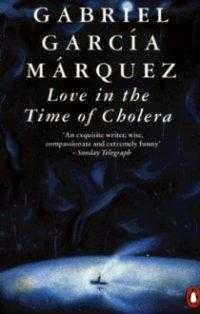
Title: Love in the Time of Cholera
Author: Gabriel García Márquez, translated by Edith Grossman
Country: Colombia
Year: 1985
Rating: A-
Pages: 348
There are already some great reviews of this book out there: Eva at A Striped Armchair, Tanabata at In Spring it is the Dawn, Nymeth at Things Mean A Lot, and Chris at Book-A-Rama have all read Love in the Time of Cholera this year.
First sentence: It was inevitable: the scent of bitter almonds always reminded him of the fate of unrequited love.
Challenge book? I read this for the Book Awards Challenge and 2nds Challenge. It was on my list for the Expanding Your Horizons Challenge, but that doesn't start until January so I'm not going to count it.
Short summary: How long would you wait for love? Florentino Ariza is preared to wait 51 years, 9 months, and 4 days. Love in the Time of Cholera is above all a love story set in the late 19th and early 20th century; a story about all the different ways that people can love each other.
What I thought: This novel is in a style completely different from One Hundred Years of Solitude (I would not classify it as a "magical realism" novel), but it retains the lyrical, passionate, and evocative prose that Marquez is so well known for. It is a love story, but it is not only a love story--more of an in-depth look at love and obsession, and how it can change and evolve over a lifetime.
I always love the imagery in many South American novels, and Marquez is one of the masters. I would definitely recommend this book to anyone who likes magical realism, thoughtful prose, and strong character development. It is a book that demands your attention - if you don't have the time to immerse yourself, hold on to it for another day.
Interesting tidbit: In Spanish, el cólera means cholera, but la cólera means choler or anger. If you take this to the extreme, it can be used to describe warfare. In the novel, victims of the civil war are often mistaken for victims of cholera.
From the sky they could see, just as God saw them, the ruins of the very old and heroic city of Cartagene de Indias, the most beautiful in the world, abandoned by its inhabitants because of the cholera panic after three centuries of resistance to the sieges of the English and the atrocities of the buccaneers.
Someone said that cholera was ravaging the villages of the Great Swamp. Dr. Urbino, as he spoke, continued to look through the spyglass.
"Well, it must be a very special form of cholera," he said, "because every single corpse has received the coup de grace through the back of the neck."
-p.226
Scribed by
Nyssaneala
at
8:25 AM
8
reader's responses
Labels: book awards challenge, colombian lit, fiction, literature, nobel prize, seconds challenge, south american lit, world lit
Title: Esperanza Rising
Author: Pam Munoz Ryan
Country: America
Year: 2000
Rating: A
Pages: 262
First sentence: "Our land is alive, Esperanza," said Papa, taking her small hand as they walked through the gentle slopes of the vineyard.
This is the first book I have finished since Maya was born, which feels like a huge accomplishment! Now that Maya is becoming more adept at breastfeeding, I find my best reading time happens while I am nursing. I'm happy to be delving into books again. :)
Challenge book? I am counting this towards the Book Awards challenge. It is the 2002 winner of the Pura Belpre Award, which honors Latino authors whose work best portrays and celebrates the Latino cultural experience in a children's book.
Short summary: Esperanza is the daughter of a wealthy but generous landowner in Mexico. When tragedy strikes her family, Esperanza and her mother are forced to flee. They migrate to California , joining the ranks of thousands of farm workers struggling to survive during the Great Depression. Esperanza is forced to confront her new living circumstances, seeking hope and optimism in a new life.
What I thought: I loved this book, and I think it provides children and adults alike with a new perspective of the circumstances of Mexican farm workers during a time period that is better known for the plight of Oklahomans affected by the Dust Bowl. The story is based on the experiences of the author's grandmother.
In March of 1929, the federal government passed the Deportation Act that gave counties the power to send great numbers of Mexicans back to Mexico. Government officials thought this would solve the unemployment associated with the Great Depression (it didn't). COunty officials in Los Angeles organized "deportation trains" and the Immigration Bureau made "sweeps" in the San Fernando Valley and LA, arresting anyone who looked Mexican, regardless of whether or not they were citizens or in the United States legally. Many of those sent to Mexico were native born United States citizens and had never been to Mexico. The numbers of Mexicans deported during this so-called "voluntary repatriation" was greater than the Native American removals of the 19th century and greater than the Japanese-American relocations during World War II. It was the largest involuntary migration in the U.S. up to that time. Between 1929 and 1935 at least 450,000 Mexicans and Mexican Americans were sent back to Mexico. Some historians think the numbers were closer to a million.
-pg. 257-250, Author's Note
Scribed by
Nyssaneala
at
12:16 PM
3
reader's responses
Labels: american lit, book awards challenge, children's literature, fiction, mexican lit, pura belpre, women writers
Title: Eragon
Author: Christopher Paolini
Country: America
Year: 2003
Rating: C
Pages: 509
First sentence: Wind howled through the night, carrying a scent that would change the world.
Challenge book? I read this for the Unread Authors Challenge.
Short summary: Farm boy finds strange stone under strange circumstances. Stone is actually a dragon's egg, it hatches, and a dragon is born. Boy and dragon set out on an adventure to help save their world from evil.
What did I think: This one was just okay. Not bad, not great. This may sound weird, but I felt as if Eragon read like a King's Quest video game; all the plot points felt too pre-determined, as if he was going on a series of tasks to get to the next level and eventually "win". The plot was incredibly predictable, which is disappointing in any genre, but especially fantasy. The characters felt somewhat flat, especially Eragon. The writing, well, it was obvious that it was written by a teenager who may lack some life experiences, and the book screamed for better editing. I can see how Eragon could be popular with kids, but as an adult, I will not be picking up the second book in the trilogy, as I had originally planned.
Scribed by
Nyssaneala
at
10:46 AM
9
reader's responses
Labels: children's literature, fantasy, fiction, unread authors challenge
Title: To the Lighthouse
Author: Virginia Woolf
Country: British
Year: 1927
Rating: A-
Pages: 310
First sentence: "Yes, of course, if it's fine tomorrow," said Mrs. Ramsey.
Short summary: This novel takes place in three parts taking place at the summer home of an English family, the Ramseys, in the Hebrides. The first part takes place over one afternoon and evening; the second spans ten years in which the home is left unoccupied; and the third part is a morning after the ten years in which some of the original characters return to the Ramsey's summer home.
Is this for a challenge? I decided to substitute this novel for Orlando by Virginia Woolf in the TBR challenge. Both have been on my bookshelf for a very long time. I also read it for the Seconds challenge.
What I thought: Virginia Woolf is not an easy read. But she is a delight. To the Lighthouse is written in a similar stream-of-consciousness style as Mrs Dalloway (reviewed here). However, Mrs Dalloway is mostly all about Clarissa: her relation to others, and others' (servants, family, friends) in relation to her. To the Lighthouse is more a story of the interrelationships amongst a group of people, and delves into the psychology of imagination and emotion from a variety of perspectives (albeit, some of the characters are not very interesting). It is not a novel to be read for its plot. The main focus of the story is on the inner workings of the people we meet. The third section of the novel seems to drift about, and I am left wondering if this is an unintentional weakness, or a hidden purpose that shows how things can fall apart.
It may help to have a broader knowledge of Virginia Woolf's work and career, to begin to capture and understand the larger artistic aims of this novel. As I discovered with Mrs Dalloway, Woolf's novels are best enjoyed at a leisurely pace. It is another book that I hope to come back to again someday.No, she said, she did not want a pear. Indeed she had been keeping guard over the dish of fruit (without realizing it) jealously, hoping that nobody would touch it. Her eyes had been going in and out among the curves and shadows of the fruit, among the rich purples of the lowland grapes, then over the horny ridge of the shell, putting a yellow against a purple, a curved shape against a round shape, without knowing why she did it, or why, every time she did it, she felt more and more serene; until, oh, what a pity that they should do it--a hand reached out, took a pear, and spoilt the whole thing. (p.163)
Scribed by
Nyssaneala
at
2:12 PM
10
reader's responses
Labels: British Lit, classics, european lit, fiction, literature, seconds challenge, women writers