Showing posts with label american lit. Show all posts

Sunday, October 5, 2008

House of Leaves - Mark Danielewski

Title: House of Leaves
Author: Mark Danielewski
Country: USA
Year: 2000
Pages: 709 pgs.
Rating: 4 out of 5

First sentence: This book is not for you.

I first saw this novel years ago, and it caught my interest, but I never got around to reading it. Finally, about two months ago, I saw it on my brother-in-law's bookshelf, and borrowed it. I was in for quite a ride.

There is both a lot going on in the plot, and a lot of very little. The main plot, if there is such a think, is the story of a photojournalist and his family who move into a house that turns out to be a wee bit bigger on the inside than the out
side. The analysis of The Navidson Record, a documentary made by the photojournalist as his family adjusted to their new home and discovered it wasn't quite normal, is written by an old guy named Zampano, who died in his apartment. His book was discovered by Johnny Truant, a self admitted liar and druggie whose life slowly begins to spin out of control in the footnotes of the book. Rounding out the narrators is "the editors" who occasionally throw in their own two cents. It's a dizzying, fascinating book. 

You can't review House of Leaves without mentioning it's unusual styling, a postmodern piece of art. Each narrator has their own font, which really helps the reader follow what's going on and from whose perspective. As the family - and outsiders who become involved in the exploration-delve into the mysteries of the house, they are begin to expose themselves to a dark exploration of their psyche and interpersonal relationships. The text mimics both the action, and the emotional state of mind each person is in. It turns, twists, reduces to only a few words per page...it is a dizzying effect, but relatively easy to follow.

One of my favorite parts, which seems to get overlooked in reviews, is quite simple. Zampano is a blind man, and his book is reviewing a movie. What the?

Another highlight is the letters between Johnny and his mother while she was at the Whalestoe psychiatric institute. The letters are in the appendix, but they bring subtle clues to much of Johnny's narration.

Wednesday, July 30, 2008

Midwives - Chris Bohjalian

Title: Midwives
Author: Chris Bohjalian
Year: 1997
Country: USA
Pages: 372
Rating: 3 out of 5

First sentence: Throughout the long summer before my mother's trial began, and then during those crisp days in the fall when her life was paraded publicly before the county--her character lynched, her wisdom impugned--I overheard much more than my parents realized, and I understood more than they would have liked.

Midwives is the story of a homebirth gone terribly wrong. Midwife Sibyl Danforth does everything she can to save the life of one of her mothers during labor. When the mother passes away, she performs an emergency c-section to save the baby's life. When her actions are questioned, she faces the hostility of those who oppose homebirth, especially physicians and the state attorney's office. 

When I started reading Midwives, I was worried the subject matter would hit a bit too close to home. When I was pregnant, we seriously considered homebirth, however our apartment's small bathtub and thin walls did not promise a comfortable experience. Instead, I opted for the care of the Special Beginnings birth center midwives. By the time my labor rolled around, I completely trusted all four midwives. Which is why, 23 hours into my 24 hours of non-medicated labor (and 4+ hours of pushing!), when my midwife told me he (and yes, a midwife can be a he) thought I should transfer to the hospital for an emergency c-section, I didn't hesitate. He was confirming what my instinct was telling me--if not the fetalscope--that something was wrong. Maya came out 45 minutes later, with a shorter umbilical cord that was wrapped around her neck. She had also turned into the posterior position, which explained the almost two hours of almost unbearable back labor I had been dealing with.

If we would have been unable to go to a hospital, would Maya have eventually been in distress because of the umbilical cord? What about me? Thankfully, we'll never know. But with her birth still fresh in my mind, it was emotionally difficult to read the beginning of this book.

Other than that, it's a fairly enjoyable read. Right away, I could tell the author had read Ina May Gaskin, a well-known midwife, and her book Spiritual Midwifery is mentioned in the acknowledgments. I didn't particularly like the story written from the perspective of the midwife's daughter, and some of the character development fell flat. The style of writing - and topic choice - reminds me a lot of Jodi Picoult. Overall I enjoyed the story, but I'm not extremely motivated to pick up another one of his books.

Also reviewed by:

Thursday, May 29, 2008

Giveaway: The Blood of Flowers!


Title: The Blood of Flowers
Author: Anita Amirrezvani
Year: 2007
Country: USA/Iranian-American
Pages: 377
Rating: 4.5 out of 5

You can find the author's website here. The book was also long-listed for the 2008 Orange Prize.

First sentence: First there wasn't and then there was.

Blood of Flowers is set in 17th century Iran, and describes the journey of a young woman and her mother from a small village to the large Persian city of Isfahan. The pair are forced to migrate to Isfahan after the death of the girl's father leaves them without a dowry for her marriage. They seek out shelter and assistance in the home of a wealthy uncle. The uncle, Gostaham, is a master rug designer and colorist for Shah Abbas. Although his wife Gordiyeh treats the mother and daughter as servants, Gostaham sees a natural rug-making talent in the young girl, and begins a personal tutelage that is usually only reserved for boys.

The fourteen-year-old girl, who is never named in the novel, is a headstrong individual who tends to make rash decisions that often lead to disastrous results. One such decision puts her in a position in which she is forced to accept a sigheh--temporary marriage--to a wealthy son of a horse trader. Throughout the story, she struggles through a personal journey on many levels: arriving in an unknown city, honing her skills as a rugmaker, but most importantly, growing into a greater maturity level while staying true to her inner spirit.

The tradition of rug-making is explored in-depth, and is a delight to read about; Amirrezvani describes this rich tradition in a beautiful, insightful prose. Folktales are interspersed throughout the narrative in a style reminiscent of Arabian Nights, paying homage to Iran's rich oral tradition. One of my favorite aspects of the book is the description of the Isfahan. All of my senses were awakened with the lush descriptions of the city's great square--The Image of the World--and the adjacent bazaar filled with thousands of vendors selling food, spices, carpets, wool, shoes, leather, in a cacophony of food, culture, and entertainment.

Historical fiction is a wide, varied genre, and has its fill of not-so-great books. Blood of Flowers is definitely one of the more original stories in this genre that I have read in a while. This story is about a girl in a male-dominated culture wishing for more independence, as well as a rich description of the arts-centered Persian culture and traditions of the 17th century. The paperback edition includes a conversation with the author, where she hints at another novel exploring Iranian history. I am eagerly looking forward to her next publication! I also greatly appreciated her recommended reading appendix. I love when books include these lists, and while I have read a few on the list, and already have a few mentioned on my TBR list, there were enough new-to-me titles named to get this book lover's heart racing.
"All our labors were in service of beauty, but sometimes it seemed as if every thread in a carpet had been dipped in the blood of flowers." (p.351)
More quotes from the novel can be found in my last Sunday Salon post here.

Blood of Flowers Giveaway
The publisher was kind enough to include an extra copy of the book along with my review copy, so I will be giving away a copy to one lucky reader! All you have to do is leave a comment on this post. The drawing will remain open until Friday, June 6th, at 5pm EST. You can receive an extra entry--and double your chances of winning-by linking to this giveaway on your blog. Just leave a link in the comment section. Sorry to those outside North America, but this contest is only open to those in the United States and Canada.

Wednesday, May 7, 2008

Snow Flower and the Secret Fan - Lisa See

Title: Snow Flower and the Secret Fan
Author: Lisa See
Country: USA
Year: 2005
Pages: 269 pgs.
Rating: 3.5 out of 5

First sentence: I am what they call in our village "one who has not yet died"--a widow, eighty years old.

See's historical novel takes place in a remote part of China during the 19th century - a time when all girls had there feet bound at the tender age of seven, marriages were arranged by the time they were ten, and women were confined to the upstairs room of their home for the majority of their life. We meet Lily, daughter of a farmer, and Snow Flower, who is the descendent of a wealthy, respected family. They are paired up as laotong, or "old sames" in a match meant to last a lifetime, a bond that is stronger than marriage. Communicating through nu shu, a secret women's language, Lily and Snow Flower send messages to each other on a fan, sharing their hopes and dreams.

It has taken me a long time to work out a review for this novel. One reason is my currently chaotic life as we prepare to pack up and move out-of-state. But I have also had a hard time putting into words what I feel about this book. On a purely entertainment level, it is a wonderful read. However, Lisa See's American perspective dominates the novel, and I felt she really didn't have a firm grasp of the culture and time period of 19th century Hunan China to write this story. It is not necessarily a book to read for insight into Chinese history and customs, as I fear it may be filled with inaccuracies. For that I would recommend Wild Swans: Three Daughters of China by Jung Chang.

Saturday, February 16, 2008

Lean Mean Thirteen


Title: Lean Mean Thirteen

Author: Janet Evanovich
Country: USA
Year: 2007
Pages: 320
Rating: 3 out of 5

First sentence: For the last five minutes, I'd been parked outside my cousin Vinnie's bail bonds office in my crapola car, debating whether to continue with my day, or return to my apartment and crawl back into bed.

I read the latest in the Stephanie Plum series for both the Themed Reading Challenge and the Series challenge. Some of the latest books in the series haven't been the best, and this one would fall under that category, but is still gave me a few laughs. I particularly enjoyed the comedic takes on the problems of getting the cable company to come out and fix anything. That is something I can completely relate to.

What is really starting to bother me about this series is it is becoming way too predictable, and there is no longer any progression forward in the over-arching story line or further character development. I am quickly becoming tired of the love triangle between Stephanie/Morelli/Ranger. Stephanie keeps getting into the same situations, makes the same mistakes, and plays the same games with the two men in her life. It's getting a bit old; it might be time for this series to start to wrap up.

Wednesday, February 13, 2008

The Bluest Eye - Toni Morrison

Title: The Bluest Eye
Author: Toni Morrison
Country: USA
Year: 1970
Rating: 4.5 out of 5
Pages: 216

First sentence: Quiet as it's kept, there were no marigolds in the fall of 1941.

The Bluest Eye embodies why I usually give an author a second chance if I did not like the first of their books I pick up. I read Song of Solomon a few years ago, and was not very impressed. Something about Toni Morrison stuck with me, however, and I vowed to give her another chance someday. With this, her first novel, she has completely won me over.

Told mainly from the perspective of Claudia and her sister Frieda, The Bluest Eye is a story about their friend Pecola, a young black girl growing up in Lorain, Ohio in 1941. By the second sentence of the novel, the reader has a glimpse of the direction the novel is set to go: 

We thought, at the time, that it was because Pecola was having her father's baby that the marigolds did not grow. (p. 1) 

What follows is a heart-breaking story about the slow destruction of one girl's hope in life.

What Pecola hopes for, wishes for more than anything, is blue eyes. Immersed in a culture that placed a higher value on lighter skin--even amongst the African-American community--Pecola's poverty, unruly hair, and dark skin leave her open to ridicule by her peers:

It was their contempt for their own blackness that gave the first insult its teeth. They seemed to have taken all of their smoothly cultivated ignorance, their exquisitely learned self-hatred, their elaborately designed hopelessness and sucked it all up into a fiery cone of scorn that had burned for ages in the hollows of their minds--cooled--and spilled over lips of outrage, consuming whatever was in its path. (p. 65)

Pecola is ignored by teachers in the classroom. On the playground and in the streets she is taunted and spat upon by other young children. When she encounters that "higher class" of black person (lighter skin, educated, polished), she is viewed as follows:

She had seen this little girl all of  her life. Hanging out of windows over saloons in Mobile, crawling over the porches of shotgun houses on the edge of town, sitting in bus stations holding paper bags and crying to mothers who kept saying "Shet up!" Hair uncombed, dresses falling apart, shoes untied and caked with dirt. They had stared at her with great uncomprehending eyes. Eyes that questioned nothing and asked everything. Unblinking and unabashed, they stared up at her. The end of the world lay in their eyes, and the beginning, and all the waste in between. (p.92)

This is a story about many things. Race relations in the 1940's. Child abuse. Bullying. The theme that struck the most resonant chord with me the treatise on beauty; why and how a young, innocent child can be considered ugly by her whole community. The last paragraph of the novel--I won't share it here, after all, it is the last paragraph--will haunt my mind for a long time to come.

Wednesday, February 6, 2008

The Road - Cormac McCarthy

Title: The Road
Author: Cormac McCarthy
Country: USA
Year: 2006
Rating: 4 out of 5
Pages: 287

First sentence: When he woke in the woods in the dark and the cold of the night he'd reach out to touch the child sleeping beside him.

I meant to read this book for the NYT Notable Challenge last year. I was even fortunate enough to win a copy in the October giveaway at Estella's Revenge. Yet I never got around to it, partially because of the bleak subject matter, and in part because of its selection as an Oprah book. I picked it up on a whim last week, and plunged right in.

The Road is a bleak, dismal novel. A father and son are travelling south on a road in a world utterly destroyed by a cataclysmic event that occurred years prior to the novel's setting, possibly caused by nuclear warfare. The plot consists of a few basic activities: walk, forage, starve, rain, sleep, starve, and walk some more. The whole world has been reduced to ash and gray snow; the only sustenance that remains are canned goods hidden away in long-abandoned homes. The narrative is simple; it is as if the father and son do not have enough energy to utter more words than the practical and essential.

They looked at each other.
One more.
I dont want you to get sick.
I wont get sick.
You havent eaten in a long time.
I know.
Okay. (p.141)

In this world, negative contractions are laid bare without their apostrophe's, and quotation marks are extinct. I wonder if the apocalypse burned all of the punctuation, or if this style is consistent in McCarthy's novels? 

One theme that particularly stood out was the reference to the father and son "carrying the fire".

We wouldnt ever eat anybody, would we?
No. Of course not.
Even if we were starving?
We're starving now.
You said we werent.
I said we werent dying. I didnt say we werent starving.
But we wouldnt.
No. We wouldnt.
No matter what.
No. No matter what.
Because we're the good guys.
Yes.
And we're carrying the fire.
And we're carrying the fire, yes.
Okay.
(p.128)

-and-

You cant. You have to carry the fire.
I dont know how to.
Yes you do.
Is it real? The fire?
Yes it is.
Where is it? I dont know where it is.
Yes you do. It's inside you. It was always there. I can see it.
(p.278)

What is McCarthy's meaning? At first, I thought it meant that the young boy was a symbol of the continuation of the human race. After finishing the whole novel, I'm more inclined to think that "carrying the fire" refers to never losing hope. If you always carry hope, you will survive. I like this interpretation, it creates a positive note in one very depressing book.
 
The Road also introduced some vocabulary unfamiliar to me. McCarthy must be a walking dictionary. Here are a few examples:
Gryke (p.11) - a deep cleft in a bare limestone rock surface.
Gambreled (p.17) - A grambrel is a two-sided roof, usually symmetric, with two slopes on each side.
Laved (p.38) - to wash or flow against.
Soffits (p.106) - the exposed undersides of any overhead component of a building.
Gelid (p.136) - Very cold; icy.
Bivouack[ed] (p. 168) - temporary encampment under little or no shelter

Friday, January 25, 2008

March - Geraldine Brooks

NaJuReMoNoMo
Title: March
Author: Geraldine Brooks
Country: USA
Year: 2005
Rating: 5 of 5
Pages: 280

First sentence: This is what I write to her: The clouds tonight embossed the sky.

I always hesitate to pick up books that are based on characters from classics, especially a classic as beloved as Lousia May Alcott's Little Women. March, by Geraldine Brooks, tells the previously untold story of the absent father. Fortunately for readers, it does not disappoint.

In this beautifully written novel, we get to experience life from Mr. March's perspective. Told largely through a series of flashbacks after he enlists as a Chaplain for the Union Army, we hear about March's childhood, his life as a young peddler in the pre-Civil War South, how he makes his fortune, and how he loses it. We learn about his dreams, hopes, failures, hopeless idealism, and indiscretions. The writing is exquisite, and sounds like an authentic voice from the past.

Brooks' detailed research of the Civil War era is evident, and I learned about aspects of the war that I had not previously known about, such as what happened to runaway slaves that crossed the federal lines during the war. Referred to as contraband, they worked on plantations taken over by Northerners for a small wage.

Like Alcott, Geraldine Brooks draws largely from Bronson Alcott's life for inspiration. Yet, this is a novel that easily stands on its own. Lovers of Little Women may not like the freedom that Brooks took with the characters, which were portrayed as an ideal family. Through this novel, they are a bit more realistic, and seen in a different light. It is a book about the harsh realities of life; she does not cast Mr. March in the role of a hero.
I promised her that I would write something every day, and I find myself turning to this obligation when my mind is most troubled. For it is as if she were here with me for a moment, her calming hand resting lightly upon my shoulder. Yet I am thankful she is not here, to see what I must see, to know what I am come to know. And with this thought I exculpate my censorship: I never promised I would write the truth. (p.4)

Monday, December 17, 2007

Moishe's Miracle and Hanukkah at Valley Forge

We read both of these books for Hanukkah this year, and they both are part of my Jewish Literature Challenge.

Title:
Moishe's Miracle: A Hanukkah Story
Author: Laura Krauss Melmed
Illustrator: David Slonim
Country: America
Year: 2000
Award: 2000 National Jewish Book Award, Children's Lit.

Starlight, star bright
Magic on a winter's nigth
White snow, candle glow
Far away and long ago...

I loved this story. LOVED IT. Moishe is a milk farmer with a truly generous spirit, always giving out extra milk and cream to villagers in need in his small town of Wishniak. His wife, Baila, worries that Moishe's generosity means they will not have enough for themselves to eat. When Moishe receives from a stranger a magic frying pan that produces as many latkes as he desires, the reader discovers the true meaning of generosity, and honesty. I love the folk tale style of this story, and the beautiful illustrations, and will be a delight to read at Hanukkah each year with our daughter. The inclusion of Yiddish and Hebrew words offer learning experiences for both mummy and daughter. :)

Title: Hanukkah at Valley Forge
Author: Stephen Krensky
Illustrator: Greg Harlin
Country: America
Year: 2006

Hanukkah at Valley Forge is the winner of the 2007 Sydney Taylor Award for Young Readers, an award that recognizes the best Jewish children's literature. This story, inspired by a true event, takes place during a bleak winter at Valley Forge (near Philadelphia, PA) in the midst of the American Revolution. General George Washington, through one of his Polish-born soldiers, learns about the history of Hanukkah, drawing a parallel between the Maccabee's war with his own fight for independence.

Geared towards slightly older beginning readers, this is a delightful book that also educates readers of the Jewish presence in early American history.

Sunday, December 9, 2007

Esperanza Rising - Pam Munoz Ryan

Title: Esperanza Rising
Author: Pam Munoz Ryan
Country: America
Year: 2000
Rating: A
Pages: 262

First sentence: "Our land is alive, Esperanza," said Papa, taking her small hand as they walked through the gentle slopes of the vineyard.

This is the first book I have finished since Maya was born, which feels like a huge accomplishment! Now that Maya is becoming more adept at breastfeeding, I find my best reading time happens while I am nursing. I'm happy to be delving into books again. :)

Challenge book? I am counting this towards the Book Awards challenge. It is the 2002 winner of the Pura Belpre Award, which honors Latino authors whose work best portrays and celebrates the Latino cultural experience in a children's book.

Short summary: Esperanza is the daughter of a wealthy but generous landowner in Mexico. When tragedy strikes her family, Esperanza and her mother are forced to flee. They migrate to California , joining the ranks of thousands of farm workers struggling to survive during the Great Depression. Esperanza is forced to confront her new living circumstances, seeking hope and optimism in a new life.

What I thought: I loved this book, and I think it provides children and adults alike with a new perspective of the circumstances of Mexican farm workers during a time period that is better known for the plight of Oklahomans affected by the Dust Bowl. The story is based on the experiences of the author's grandmother.

In March of 1929, the federal government passed the Deportation Act that gave counties the power to send great numbers of Mexicans back to Mexico. Government officials thought this would solve the unemployment associated with the Great Depression (it didn't). COunty officials in Los Angeles organized "deportation trains" and the Immigration Bureau made "sweeps" in the San Fernando Valley and LA, arresting anyone who looked Mexican, regardless of whether or not they were citizens or in the United States legally. Many of those sent to Mexico were native born United States citizens and had never been to Mexico. The numbers of Mexicans deported during this so-called "voluntary repatriation" was greater than the Native American removals of the 19th century and greater than the Japanese-American relocations during World War II. It was the largest involuntary migration in the U.S. up to that time. Between 1929 and 1935 at least 450,000 Mexicans and Mexican Americans were sent back to Mexico. Some historians think the numbers were closer to a million.
-pg. 257-250, Author's Note

Wednesday, October 24, 2007

The Giver - Lois Lowry

For the longest time, I have been wracking my brain to remember what I had read by Lois Lowry as a child. The Giver was published in 1993, when I was 14, when I had moved on to adult novels. I definitely would not have been caught reading a "children's" book during those early teen years. Same goes with Number the Stars (I was 11 when it was published, but never read it). Finally, I stumbled across her website, and looked at her book list.

Aha!

Anastasia Krupnik!!!

Before the Newbery awards, National Jewish Book Award, Sidney Taylor Award, and a gazillion other awards and recognitions, there was Anastasia Krupnik. I had completely forgotten about this delightful series that came out in the 1980's, and I am delighted to recall one of my childhood favorites from the realm of foggy memories. Yay! Can you tell how excited I am?

Ok, now that that's out of my system (stay tuned for future re-reads of the Anastasia series), I can move on to my review of The Giver.

Title: The Giver
Author: Lois Lowry
Country: America
Year: 1993
Rating: A
Pages: 179 pgs.

First sentence: It was almost December, and Jonas was beginning to be frightened.

Short Summary: Jonas lives in a world where everything is perfect and under control. When Jonas is twelve, he is singled out in his community to receive special training from the Receiver of Memories. The Receiver is the only person in the whole community that holds the memories of true pleasure and pain. Now it is Jonas' turn.

Was this a challenge book? I read this book for the BookAwards Challenge. It is the 1993 winner of the Newbery Award.

What did I think? **This might contain small spoilers**
The Giver is a though-provoking book for people of all ages. It is interesting to think about what it would be like to live in a community like Jonas': never experiencing pain, to always be content, yet having no knowledge that life could be any different. A life where you have no chocie, everything is assigned to you, including your career, spouse, and children. Where there is no true concept of feelings (or colors!). I particularly like that the ending is left ambiguous. It certainly gives the reader a lot to think about.

"Many kids want a more specific ending to The Giver. Some write, or ask me when they see me, to spell it out exactly. And I don't do that. And the reason is because The Giver is many things to many different people. People bring to it their own complicated sense of beliefs and hopes and dreams and fears and all of that. So I don't want to put my own feelings into it, my own beliefs, and ruin that for people who create their own endings in their minds."
- Interview with Lois Lowry

Le Divorce - Diane Johnson

Title: Le Divorce
Author: Diane Johnson
Country: America
Year: 1997
Rating: B
Pages: 309 pgs.

First sentence: I suppose because I went to film school, I think of my story as a sort of film.

Short summary: Isabel Walker travels to Paris to help her sister Roxy during her second pregnancy. When Roxy's french husband leaves her for a Czechoslovakian sociologist, Isabel is there to help pick up the pieces. It is a story of one girl's naivete (Isabel), as well as a larger look of American ex-pat life in Paris.

Is this for a challenge? Not really, although it does fit into the Book to Movies challenge.

What I thought: This book is fairly good. It was definitely a lighter read, but that's just what I needed. Diane Johnson is a gifted writer. I did not like any of the characters, with the exception of the delightful Mrs Pace, but I don't need to like the characters to enjoy a story. I have never visited France, but I felt as if she exaggerated the stereotypes and cliches, although this could have been done on purpose. The whole novel struck me as slightly comical, poking fun at both American and French idiosyncrasies. The only major drawback was the loose threads of some of the plot lines at the end. I thought there would be a sequel, but there isn't one. I would like to know more about the files of Mrs Pace!

Saturday, October 20, 2007

God is Dead - Ron Currie, Jr.

Title: God Is Dead
Author: Ron Currie Jr.
Country: America
Year: 2007
Rating: A-
Pages: 182 pgs.

"They did start the war. They are savages. This is precisely the reason that, even in societies as advanced and enlightened as ours, principles must sometimes be sacrificed in order to meet and overcome threats." (p. 122)

First sentence: Disguised as a young Dinka woman, God came at dusk to a refugee camp in the North Darfur region of Sudan.

Short Summary: A wounded Dinka woman arrives at a refugee camp, looking for her lost brother. It turns out the woman is God in human form, and when she is killed, news spreads around the world about God's demise. What follows is a series of short vignettes, some with overlapping characters, of what happens in the years that follow.

What did I think: If you swallow the fantastical fact in the first chapter of this novel (God's death), you are in for an unbelievable ride into what could happen when the whole world simultaneously experiences a spiritual vacuum. The societal changes that occur are an echo of things already happening in our world today, taken to the extreme. This satire is also infused with a subtle humor that brings the whole story up a notch: a street-talking Colin Powell that actually stands up to the Bush Administration, feral dogs who feasted on God's human body suddenly becoming philosophical and speaking numerous foreign languages. It is not a story for its religious message, as some may think, but an insightful commentary on certain aspects of our culture that already exist (as the quote I chose above hints at this thought). It is a wonderful piece of debut fiction.

What I didn't like: I feel that I did not catch all of the connections between the characters. Sometimes I felt that someone was introduced that I might have met before at another stage in their life, but I wasn't sure. Another re-reading may help work this one out, and I believe it is a book that lends itself well to multiple readings.

Monday, October 15, 2007

A Thousand Splendid Suns - Khaled Hosseini


Title: A Thousand Splendid Suns
Author: Khaled Hosseini
Country: American/Afghan
Year: 2007
Rating: A-
Pages: 372 pgs.

First sentence: Mariam was five years old the first time she heard the word harami.

What I thought: It's difficult to follow a first novel with the acclaim that The Kite Runner has, which happens to be one of my favorite books. For the most part, A Thousand Splendid Suns stands on its own. It is a powerful story of two generations of women living in Afghanistan over the span of three decades. Their stories are intricately woven with the modern history of Afghanistan. I really enjoyed reading this novel, but did feel at times as if this history became the main character of the story, rather than Mariam and Laila.

Friday, September 28, 2007

Girl in Hyacinth Blue - Susan Vreeland


Title: Girl in Hyacinth Blue
Author: Susan Vreeland
Country: America
Year: 1999
Rating: C-
Pages: 242 pgs.

First sentence: Cornelius Engelbrecht invented himself.

I don't enjoy writing reviews about books that I don't like. After all, I'm just one opinion, and by no means an expert. Why slander a book? But, if I only ever posted reviews of books I enjoy, would that be helpful?

I was very disappointed in Girl in Hyacinth Blue. The story is set up as a series of vignettes (many of them were first printed as short stories as it states in the Acknowledgments). As I started reading I wondered how she could publish so many of the individual chapters on their own, while still creating a cohesive novel. My question was answered, as I discovered the novel was not very cohesive at all.

The plot is an interesting one. The first chapter presents us with a modern day owner of a painting he claims to be a Vermeer formerly unknown to the art world. Each chapter traces the ownership of the painting, Girl in Hyacinth Blue, back to the original owner and creator.

However, Vreeland's technique does not seem to work as the painting at the centerpiece of the novel. Very few of the stories flow well together. I was left unsatisfied, wondering what happens to some of the people in each chapter, or trying to figure out how others fit into the overall history of the painting. Large gaps of time seem to be present, and I had a hard time following the chronology and how the painting was passed between owners. Never mind the fact that the last two chapters don't even adhere to her reverse chronology.

Some novels don't have a resolution, and it works. This one doesn't have a resolution, but as a reader I ended up more frustrated and annoyed. It doesn't even have a proper ending. You never return to the original narrator and finds out what happens to the painting in the modern day. Ultimately, for a book of such small size, it took an extremely long time to finish, and I've already forgotten a lot of the details.

Thursday, September 20, 2007

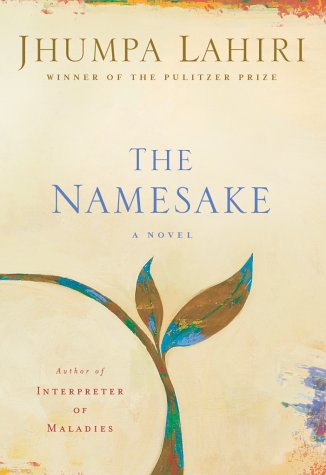
The Namesake - Jhumpa Lahiri

Title: The Namesake
Author: Jhumpa Lahiri
Country: America
Year: 2003
Rating: A-
Pages: 291 pgs.

First sentence: On a sticky August evening two weeks before her due date, Ashima Ganguli stands in the kitchen of a Central Square apartment, combining Rice Krispies and Planters peanuts and chopped red onion in a bowl.

The novel begins in 1968 with the birth of a boy named Gogol Ganguli. His mother, having recently emigrated to America after an arranged marriage to Ashoke, "is terrified to raise a child in a country where she is related to no one, where she knows so little, where life seems so tentative and spare." (p.6) Yet Gogol is born, and comes by his name through a series of random occurences. Despite the randomness of his naming, it is a name that holds personal meaning for his father Ashoke.

The family, soon to include a daughter Sonia, slowly find their way, balancing the old and the new. The Namesake is not only a coming-of-age story; it is a family portrait of a Bengali couple raising their children in a new culture. Lahiri adeptly captures the disparities between parents who view their country of origin as home, but raise American children who abandon their ethnic identity and squirm in discomfort on each visit 'home' to Calcutta. Although the story centers around Gogol and his search to become reconciled with his identity, we follow each family member as they search out their own path. I would definitely recommend this story of individual growth amidst family (and cultural) relationships.

Thursday, August 30, 2007

Ahab's Wife - Sena Jeter Naslund

Title: Ahab's Wife or, The Star-Gazer
Author: Sena Jeter Naslund
Country: America
Year: 1999
Rating: B+
Pages: 668 pgs.

First sentence: Captain Ahab was neither my first husband nor my last.

With this first sentence, Sena Jeter Naslund sets the scene for a historical novel that brings the female perspective to an American classic, Moby Dick. Through the eyes of Una, we are given a glimpse into mid-19th century America, a time when abolition was beginning to gain momentum, whaling was an acceptable trade, and transcendentalism abounded (at least in Una's realm).

Although slow to start, I ultimately enjoyed this epic novel. The first 100 pages or so dragged as you first meet Una as a young girl living in the Kentucky frontier. Raised by a liberal, Quaker mother, and a fundamentalist Christian father, somehow Una grows up agnostic. Her religious differences with her father finally lead her parents to send her to New England, where her Aunt and Uncle maintain a lighthouse on a small island. It is here that the story picks up in its momentum. We follow Una as she experiences the world, partaking in her own adventures, which eventually lead her to Captain Ahab and beyond. The story could be described as adventure, but overall it is a romantic novel. A very well-written one.

Ahab's Wife, as attested by numerous reviews on Amazon and elsewhere, certainly has its flaws. I do not believe that Naslund set out to write a masterpiece, as so many reviewers cite her for failing in this goal. Una herself sometimes does come across as flat and unchanging, and although I really liked her, I found myself drawn more to the outlying characters (Mrs Maynard, Aunt Agatha, Uncle Torchy, Mary Starbuck and the Judge were some of my favorites). Although I felt that overall it worked quite well, famous individuals of the time do make somewhat random appearances--the most glaringly contrived is that of Una's run-in with Henry David Thoreau.

But you know what? I don't care. Simply for the fact that I enjoyed reading this book. It kept me up at nights, a feat which usually only occurs with mysteries and other suspenseful books. I felt the story was truly entertaining. And isn't that what reading for fun is all about? Ahab's Wife is simply a good, well-written story. I initially picked up this book since Naslund will be at the National Book Festival in Washington, DC in September. I definitely look forward to hearing her speak and delving into her latest novel, Abundance: A Novel of Marie Antoinette.

A runaway slave Wanted poster on a steamboat in Kentucky (Una's mother tore it down):

WANTED
Large, strong, coal-black $800 male Shifty eyed,
bit-broke teeth on left
Clover-leaf brand left shoulder
Dangerous and Desperate
$50 for information
$500 for return to Sweet Clover Farm
(p.25)
A personal revelation:
Since my time on the Sussex, I have ever feared the weathervane in me. Sometimes I point toward Independence, isolation. Sometimes I rotate--my back to Independence--and I need and want my friends, my family, with a force like a gale. I have in me a spinnaker sail that finds the breeze and leads all my sails in that direction. (p.190)
An interesting cure for that dreaded female 'disease', hysteria:
And very soon I was eating buttered toast, followed by bacon, followed by fish, followed by oatmeal--all to ward off hysteria. And it worked very well. After a while, the judge took up business again.

Tuesday, August 21, 2007

Some Light Reading

Title: Shopaholic and Sister
Author: Sophie Kinsella
Country: America
Year: 2004
Rating: C-
Pages: 352 pgs.

This was my least favorite of the Shopaholic series. But, I have heard that her latest, Shopaholic and Baby, is better, so I will probably continue with this light, chick lit series. It's great for when I am in the mood for complete fluff!

Title: I is for Innocent
Author: Sue Grafton
Country: America
Year: 1992
Rating: B
Pages: 343 pgs.

I never get tired of Kinsey Millhone and her many adventures.

Monday, August 13, 2007

To Kill A Mockingbird - Harper Lee

Title: To Kill A Mockingbird
Author: Harper Lee
Country: America
Year: 1960
Rating: A
Pages: 323 pgs.

First sentence: When he was nearly thirteen, my brother Jem got his arm badly broken at the elbow.

Finally. I can finally say I have read To Kill A Mockingbird, an achievement that is long, long overdue. I'm not sure how I managed to make it through school without having to read this modern American classic. It was also a delight to read one of the original reviews, About Life & Little Girls, published in Time in 1960.

In Maycomb, Alabama, which is rumored to be based upon Lee's hometown of Monroeville, everybody knows everybody else, and almost everybody is related to you in one way or another. And, as I'm sure many of you are familiar with the unforgettable characters of Scout, Jem, Atticus, and Dill--and the many wonderful neighbors Miss Maudie, Miss Rachel, and the Radleys--I will not rehash the storyline here.

I'm always hesitant to begin a book that I have heard so much about, and To Kill A Mockingbird certainly has its fair share of acclaim. Fortunately, I feel it completely lives up to the hype. I was drawn in to the story from page one, and felt it was a wonderful portrayal of many of this issues going on in the 1930's South: racism, social class differences, Southern chivalry and what that meant at that time, and what courage is.

This was my last book for Maggie's Southern Reading Challenge , and a wonderful note to end it on (I'm also reading it for the Book Awards challenge). To cap it off, I made a quintessential Southern summer dessert. No, not pe-khan pie. :) But the next best thing, a scrumptious peach pie. We picked up a bushel of peaches at the market this weekend, and boy are they good! It was the first time I had ever made a fruit-filled pie. I've always been more of a cook than a baker, and struggle with desserts, but I must say this pie was divine! I had hoped to photograph my very first peach pie, but we, ah, dove into it before I remembered the camera. Ah well, y'all just have to use your 'magination.

More than meets the eye:
'Nobody knew what form of intimidation Mr. Radley employed to keep Boo out of sight, but Jem figured that Mr. Radley kept him chained to the bed most of the time. Atticus said no, it wasn't that sort of thing, that there were other ways of making people into ghosts.' (p. 12)

Simple delights:
'Summer was on the way; Jem and I awaited it with impatience. Summer was our best season: it was sleeping on the back screened porch in cots, or trying to sleep in the treehouse; summer was everything good to eat; it was a thousand colors in a parched landscape; but most of all. summer was Dill.' (p. 38)

On courage:
"I wanted you to see what real courage is, instead of getting the idea that courage is a man with a gun in his hand. It's when you know you're licked before you begin but you begin anyway and you see it through no matter what." (p. 112)

Young love:
'With him [Dill], life was routine; without him, life was unbearable. I stayed miserable for two days.' (p. 132)

Wednesday, August 8, 2007

Hilda and Pearl - Alice Mattison

Title: Hilda and Pearl
Author: Alice Mattison
Country: America
Year: 1995
Rating: C
Pages: 293 pgs.

First sentence: Hilda said she'd take the plums back to the cottage with her, because if she left them at the lake no one would remember to bring them.

Hilda and Pearl begins from the viewpoint of Frances, an only child living in the McCarthy-era New York. However, much of the story consists of flashbacks of the friendship that evolved between her mother, Hilda, and her aunt Pearl, and the secrets and tragedies hidden in that friendship.

The basic premise of this book is one that I usually like, especially the relationship between the two women. I always love settings that take place in the 30's and 40's, as it is a period of time that fascinates me. Ultimately, however, this book was disappointing. I felt much of the writing was telling me what was happening, rather than describing it. The only word I can think of to describe the book is flat, from the second I finished the book I have struggled with my overall disinterest in how to write a review.

I have one of Alice Mattison's other books, The Book Borrower, on my bookshelf, but I don't know if I want to give her a second chance. Has anyone read The Book Borrower? What did you think?