Showing posts with label nobel prize. Show all posts

Wednesday, February 13, 2008

The Bluest Eye - Toni Morrison

Title: The Bluest Eye
Author: Toni Morrison
Country: USA
Year: 1970
Rating: 4.5 out of 5
Pages: 216

First sentence: Quiet as it's kept, there were no marigolds in the fall of 1941.

The Bluest Eye embodies why I usually give an author a second chance if I did not like the first of their books I pick up. I read Song of Solomon a few years ago, and was not very impressed. Something about Toni Morrison stuck with me, however, and I vowed to give her another chance someday. With this, her first novel, she has completely won me over.

Told mainly from the perspective of Claudia and her sister Frieda, The Bluest Eye is a story about their friend Pecola, a young black girl growing up in Lorain, Ohio in 1941. By the second sentence of the novel, the reader has a glimpse of the direction the novel is set to go: 

We thought, at the time, that it was because Pecola was having her father's baby that the marigolds did not grow. (p. 1) 

What follows is a heart-breaking story about the slow destruction of one girl's hope in life.

What Pecola hopes for, wishes for more than anything, is blue eyes. Immersed in a culture that placed a higher value on lighter skin--even amongst the African-American community--Pecola's poverty, unruly hair, and dark skin leave her open to ridicule by her peers:

It was their contempt for their own blackness that gave the first insult its teeth. They seemed to have taken all of their smoothly cultivated ignorance, their exquisitely learned self-hatred, their elaborately designed hopelessness and sucked it all up into a fiery cone of scorn that had burned for ages in the hollows of their minds--cooled--and spilled over lips of outrage, consuming whatever was in its path. (p. 65)

Pecola is ignored by teachers in the classroom. On the playground and in the streets she is taunted and spat upon by other young children. When she encounters that "higher class" of black person (lighter skin, educated, polished), she is viewed as follows:

She had seen this little girl all of  her life. Hanging out of windows over saloons in Mobile, crawling over the porches of shotgun houses on the edge of town, sitting in bus stations holding paper bags and crying to mothers who kept saying "Shet up!" Hair uncombed, dresses falling apart, shoes untied and caked with dirt. They had stared at her with great uncomprehending eyes. Eyes that questioned nothing and asked everything. Unblinking and unabashed, they stared up at her. The end of the world lay in their eyes, and the beginning, and all the waste in between. (p.92)

This is a story about many things. Race relations in the 1940's. Child abuse. Bullying. The theme that struck the most resonant chord with me the treatise on beauty; why and how a young, innocent child can be considered ugly by her whole community. The last paragraph of the novel--I won't share it here, after all, it is the last paragraph--will haunt my mind for a long time to come.

Thursday, December 20, 2007

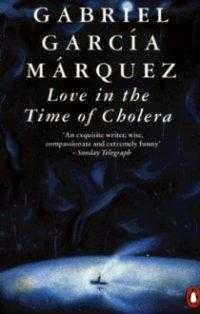
Love in the Time of Cholera - Gabriel Garcia Marquez

Title: Love in the Time of Cholera
Author: Gabriel García Márquez, translated by Edith Grossman
Country: Colombia
Year: 1985
Rating: A-
Pages: 348

There are already some great reviews of this book out there: Eva at A Striped Armchair, Tanabata at In Spring it is the Dawn, Nymeth at Things Mean A Lot, and Chris at Book-A-Rama have all read Love in the Time of Cholera this year.

First sentence: It was inevitable: the scent of bitter almonds always reminded him of the fate of unrequited love.

Challenge book? I read this for the Book Awards Challenge and 2nds Challenge. It was on my list for the Expanding Your Horizons Challenge, but that doesn't start until January so I'm not going to count it.

Short summary: How long would you wait for love? Florentino Ariza is preared to wait 51 years, 9 months, and 4 days. Love in the Time of Cholera is above all a love story set in the late 19th and early 20th century; a story about all the different ways that people can love each other.

What I thought: This novel is in a style completely different from One Hundred Years of Solitude (I would not classify it as a "magical realism" novel), but it retains the lyrical, passionate, and evocative prose that Marquez is so well known for. It is a love story, but it is not only a love story--more of an in-depth look at love and obsession, and how it can change and evolve over a lifetime.

I always love the imagery in many South American novels, and Marquez is one of the masters. I would definitely recommend this book to anyone who likes magical realism, thoughtful prose, and strong character development. It is a book that demands your attention - if you don't have the time to immerse yourself, hold on to it for another day.

Interesting tidbit: In Spanish, el cólera means cholera, but la cólera means choler or anger. If you take this to the extreme, it can be used to describe warfare. In the novel, victims of the civil war are often mistaken for victims of cholera.

From the sky they could see, just as God saw them, the ruins of the very old and heroic city of Cartagene de Indias, the most beautiful in the world, abandoned by its inhabitants because of the cholera panic after three centuries of resistance to the sieges of the English and the atrocities of the buccaneers.

Someone said that cholera was ravaging the villages of the Great Swamp. Dr. Urbino, as he spoke, continued to look through the spyglass.
"Well, it must be a very special form of cholera," he said, "because every single corpse has received the coup de grace through the back of the neck."
-p.226