Showing posts with label world lit. Show all posts

Monday, October 6, 2008

Pride and Prejudice - Jane Austen

Title: Pride and Prejudice 
Author: Jane Austen
Country: UK
Year: 1813
Pages: 332 pgs.
Rating: 5 out of 5

First sentence: It is a truth universally acknowledged that a single man in possession of a good fortune must be in want of a wife.

Amazingly, Pride and Prejudice is one of the remaining Austen novels I have not read (Northanger Abbey is the other one). Emma, Mansfield Park, Sense and Sensibility, Persuasion...loved them all. So I figured it was about time I pick this one up off my shelf.

Boy, I was not disappointed! It almost felt like coming back to an old friend, even though I have never read P&P before. But I know the story very well, having fallen in love with the BBC series. And I loved it. I loved it so much that I don't know what to say. It is that good. And it is jumping right up to the top of my all-time favorite lists.

It's witty - I love the early banter between Mr Darcy and Elizabeth when Jane is recovering from an illness at Mr Bingley's home. It's funny - Mr Collins just cracks me up, and you just have to laugh at Mrs Bennett's scheming. Almost 200 years later, it is still a page turner. And as much as I love reading classics, I would not describe most of them as a page turner!

It is also a comfort book. I can't help but love almost all of the characters, despite their flaws. Immersing yourself in the novel is like having a cup of tea with an old friend. It's a joy to read, and I am positive that over the years I will be reading it again...and again...and again.

In a conversation with Lady Catherine:
"I am not in the habit of being disappointed!"
"That will make your ladyship's position more pitiable; but it will have no effect upon me." (p.303)

Sunday, September 21, 2008

Independent People - Halldor Laxness

Title: Independent People
Author: Halldor Laxness
Country: Iceland
Year: 1946
Pages: 512 pages
Rating: 4 out of 5

Independent People is the story of Bjartur of Summerhouses, an Icelandic crofter who has bought his own croft after 18 years of servitude to the Bailiff of Myri. Bjartur is conservative, stubborn, and fearful of progress. He is not especially likeable, but you can't help being drawn into his plight. Bjartur prides himself on being an independent man, defining independence as freedom from servitude. However, freedom and independence from starvation, sickness, and extreme poverty are issues he confronts on a daily basis.

Halldor Laxness won the Nobel Prize in 1955, and many view Independent People as the crown of his achievements. Despite this, it remains an obscure novel--it took months to obtain a copy through the interlibrary loan system--from a small country most Americans know little about. For me, that is part of its charm.

The book is hard describe. It is about many things: Icelandic sheep farmers in the early 20th century, self-sufficiency and independence, a satirical look at Bjartur's limitations, the impact of war, and the juxtaposition of economics and politics (particularly socialism vs capitalism), all play out through the course of this epic novel. There are long discussions of ancient Icelandic poetry, for Bjartur is a poet, which really gives the story a timeless quality. Framing these themes is the relationship between Bjartur and his only daughter Asta Sollija.

Independent People certainly hold its own in comparison to other works of the time by authors such as Ernest Hemingway, John Steinbeck and Pearl S. Buck. It is a book to read when you have the time to sit down and browse slowly.

Tuesday, July 15, 2008

Snakes and Earrings - Hiromi Kanehara

Title: Snakes and Earrings (Hebi ni piasu in Japanese)
Author: Hiromi Kanehara (translated by David James Karashima)
Year: 2004
Country: Japan
Pages: 120
Rating: 3 out of 5

 First sentence: "Know what a forked tongue is?"

Snakes and Earrings is as much a story about disillusioned youth as it is about the young Japanese counter-culture. Lui is a 19 year old girl who travels away from her "Barbie-girl" image once she meets Ama. She is mesmerized by his forked tongue, an extreme form of body modification, and she spontaneously sets out to split her own tongue, moving in with Ama as well. The short novella is filled with S&M, anorexia, alcoholism, and drugs.

The tattoos, forked tongues, and piercing', and other physical transformations hint at the underlying mental transformations that Lui is faced with by the end of the novel. It is one of those stories in which the end is only the beginning, and I am left wondering where her life will ultimately lead her.

I have been meaning to read a book about the youth counter-culture in Japan, but I think that craving would be better served with non-fiction. Ultimately, this was a quick read (I read it in one sitting at the beach), but not particularly satisfying. Snakes and Earrings did win the Akutagawa literature prize in 2003.

Also reviewed by:

If you have reviewed this book and would like your review listed here, just let me know!

Saturday, June 28, 2008

The Yacoubian Building - Alaa Al Aswany

Title: The Yacoubian Building (Imarat Ya'qubyan in Arabic)
Author: Alaa Al Aswany (translated by Humphrey Davies)
Year: 2002
Country: Egypt
Pages: 253
Rating: 5 out of 5

First sentence: The distance between Baehler Passage, where Zaki Bey el Dessouki lives, and his office in the Yacoubian building is not more than a hundred meters, but it takes him an hour to cover it each morning as he is obliged to greet his friends on the street.

In The Yacoubian Building, a look at the residents of the title's namesake reveals the overlapping layers of Egyptian culture and politics. They represent the multiple facets of modern Egyptian society: the old, the new, and everything in between. 

Zaki Bey el Dessouki, one of the Yacoubian building's longest-residing tenants, is the son of a former prime minister, and was one of Egypt's wealthiest men before the Revolution. 
Busayna tried pushing him gently so they could cross the street, but he went on, "You know,Busayna, I feel as though I owned the Yacoubian Building. I'm the longest resident in it. I know the history of every individual and every square meter in the building. I've spent most of my life in it. I lived my best days in it and I feel as though it's a part of me. The day this building's demolished or something happens to it, that'll be the day I die." (p. 165)
Hatim Rasheed is the homosexual son of aristocrats, whose mother is French. Hagg Azzam is nouveau rich, a self-made millionaire who started out as an immigrant shoe shiner on the streets of Cairo. Taha el Shazli, the doorkeeper's son, is an observant Muslim who is lured to fundamentalism after his dream of becoming a police officer is denied to him due to his family's poverty and low social status. Busayna, Taha's childhood sweetheart, also resides on the rooftop of the Yacoubian building and is subject to overwhelming sexual harrassment as she struggles as the sole income-earner for her mother and siblings.

The sheer number of main characters followed throughout the story can at times be hard to follow, but is well worth the frequent reference to the "Cast of Characters" given at the beginning of the novel. The story paints a vivid and insightful portrait of Egyptian society for the reader, and sets a high standard (along with Naguib Mahfouz) for some of the other Egyptian literature I have on my TBR pile.

About the real Yacoubian building: The Yacoubian building does exist at the address given in the novel. A six-story building, it was built by Nishan Yacoubian, an Armenian, in the 1930's.

Also reviewed by:

Tuesday, June 3, 2008

Cheri and The Last of Cheri - Colette

Title: Chéri and The Last of Chéri

Author: Colette
Country: France
Year: 1920 and 1926
Pages: 247
Rating: 5 out of 5

First sentence (Chéri): Give it me, Léa, give me your pearl necklace! 
First sentence (The Last of Chéri): Chéri closed the iron gate of the little garden behind him and sniffed the night air: 'Ah! it's nice out here!'

For a more detailed analysis of the first novella, check out my Sunday Salon post.

The Last of Chéri picks up five years after the end of Chéri. In between, World War I has happened. Chéri seems to be one of the fortunate; he returns home not only alive, but unscathed (at least physically). His wife is fulfilling her patriotic duty working as a nurse at a Parisian verteran's hospital, and financially, he could want for nothing. Yet, while Chéri was sensual, The Last of Chéri is a chilling masterpiece. Unlike the first, this time around we only see the world from Chéri's narcissistic perspective. After visiting a much-aged Léa, he delves into a semi-manic depression, spurred on by his demands on another aged courtesan to recount Léa's younger life.

In all, this has been a great pair of novels to read. I also heard that a film version will be coming out in 2009, with Michelle Pfeiffer in the role of Léa, and Kathy Bates as Madame Peloux (Chéri's mother). I have a feeling it's not going to be in French, but I'm interested to see what they do with it.

Chéri never forgot their nocturnal journey home, the sadness of the lingering crimson in the west, the smell of the grasses, the feathery moths held prisoner in the beam of the headlamps. (p.167)

She put back the receiver, showing nothing but the curve of her back. As she moved away, she inhaled and exhaled puffs of blue smoke, and vanished in the midst of her cloud like a magician whose task is accomplished. (p. 181)
 

Thursday, May 29, 2008

Giveaway: The Blood of Flowers!


Title: The Blood of Flowers
Author: Anita Amirrezvani
Year: 2007
Country: USA/Iranian-American
Pages: 377
Rating: 4.5 out of 5

You can find the author's website here. The book was also long-listed for the 2008 Orange Prize.

First sentence: First there wasn't and then there was.

Blood of Flowers is set in 17th century Iran, and describes the journey of a young woman and her mother from a small village to the large Persian city of Isfahan. The pair are forced to migrate to Isfahan after the death of the girl's father leaves them without a dowry for her marriage. They seek out shelter and assistance in the home of a wealthy uncle. The uncle, Gostaham, is a master rug designer and colorist for Shah Abbas. Although his wife Gordiyeh treats the mother and daughter as servants, Gostaham sees a natural rug-making talent in the young girl, and begins a personal tutelage that is usually only reserved for boys.

The fourteen-year-old girl, who is never named in the novel, is a headstrong individual who tends to make rash decisions that often lead to disastrous results. One such decision puts her in a position in which she is forced to accept a sigheh--temporary marriage--to a wealthy son of a horse trader. Throughout the story, she struggles through a personal journey on many levels: arriving in an unknown city, honing her skills as a rugmaker, but most importantly, growing into a greater maturity level while staying true to her inner spirit.

The tradition of rug-making is explored in-depth, and is a delight to read about; Amirrezvani describes this rich tradition in a beautiful, insightful prose. Folktales are interspersed throughout the narrative in a style reminiscent of Arabian Nights, paying homage to Iran's rich oral tradition. One of my favorite aspects of the book is the description of the Isfahan. All of my senses were awakened with the lush descriptions of the city's great square--The Image of the World--and the adjacent bazaar filled with thousands of vendors selling food, spices, carpets, wool, shoes, leather, in a cacophony of food, culture, and entertainment.

Historical fiction is a wide, varied genre, and has its fill of not-so-great books. Blood of Flowers is definitely one of the more original stories in this genre that I have read in a while. This story is about a girl in a male-dominated culture wishing for more independence, as well as a rich description of the arts-centered Persian culture and traditions of the 17th century. The paperback edition includes a conversation with the author, where she hints at another novel exploring Iranian history. I am eagerly looking forward to her next publication! I also greatly appreciated her recommended reading appendix. I love when books include these lists, and while I have read a few on the list, and already have a few mentioned on my TBR list, there were enough new-to-me titles named to get this book lover's heart racing.
"All our labors were in service of beauty, but sometimes it seemed as if every thread in a carpet had been dipped in the blood of flowers." (p.351)
More quotes from the novel can be found in my last Sunday Salon post here.

Blood of Flowers Giveaway
The publisher was kind enough to include an extra copy of the book along with my review copy, so I will be giving away a copy to one lucky reader! All you have to do is leave a comment on this post. The drawing will remain open until Friday, June 6th, at 5pm EST. You can receive an extra entry--and double your chances of winning-by linking to this giveaway on your blog. Just leave a link in the comment section. Sorry to those outside North America, but this contest is only open to those in the United States and Canada.

Tuesday, May 20, 2008

The Sea, The Sea - Iris Murdoch

Title: The Sea, The Sea
Author:
Iris Murdoch
Country:
UK
Year:
1978
Pages:
502
Rating:
5 out of 5

First sentence:
The sea which lies before me as I write glows rather than sparkles in the bland May sunshine.

The Sea, the Sea starts out in the form of a journal, written by Charles Arrowby, a newly retired playwright/actor/director, who has adjourned to an old house outside a small village on the English coastline. He has decided to leave the London scene for good, and spends his time cooking simple meals--poached eggs on nettles, spring cabbage cooked slowly with dill, porridge with brown sugar and cream, and vegetarian stew--and diving into the sea for daily swims.

The beginning of the book sets this scene, describing his meals, daily activities, and his new home in an impromptu, journalistic style. Then, about 50 pages in, two things change. First, we see Charles for the first time from an outside perspective, through the letter he receives from Lizzie, an old flame. Second, Charles spots his long-lost childhood love, Hartley, in the local village. As the book shifts focus to Charles somewhat bizarre quest to destroy Hartley's marriage and re-claim her for himself, Murdoch shifts to a more straightforward narrative technique.

The opening scenes of Charles' adjusting to a life of retirement helped me as a reader to retain a semblance of sympathy for a character that becomes quite despicable. Although I detested his actions (he seems to make the wrong decision at every turn, and succeeds in lashing out at everyone around him), I could see the unacknowledged hurt and suffering that spurred him to take those actions. I really loved the gothic undertones; there were parts of the story that sent shivers down my spine and were very unnerving, in a way that most modern horror stories fail to achieve.

At one point, Charles' cousin asks him "What is the truth anyway?" And, I spent much of the novel trying to figure that out. I never did quite succeed, but I believe that is part of Iris' point. I also loved that the sea is a character itself, and we see its many emotions: cruel, gentle, and playful, amongst others, through the course of the novel. The story was very much a page turner, and I would definitely recommend it to others!

"Jealousy is perhaps the most involuntary of all strong emotions. It steals consciousness, it lies deeper than thought. It is always there, like a blackness in the eye, it discolours the world." (p.84)

Tuesday, April 22, 2008

The Motorcycle Diaries - Ernesto "Che" Guevara

Title: The Motorcycle Diaries: Notes on A Latin American Journey
Author: Ernesto "Che" Guevara (Translated by Alexandra Keeble)
Country: Argentina
Year: 2003
Pages: 175
Rating: 2.5 out of 5

First sentence: This is not a story of heroic feats, or merely the narrative of a cynic; at least I do not mean it to be.

The Motorcycle Diaries introduces us to a young Che, Ernesto Geuvara, as he travels across Latin America with his good friend and fellow Argentinian Alberto Granado. Ernesto is a medical student; Alberto a biochemist; and they pose as doctors who have worked with lepers to garner free food and lodging on their trip. They come from a life of privilege, yet they lie, beg and plead, and pay for nothing on their trip.

I wanted to like this, but I didn't. It is immediately apparent that this was largely written after Che's journey, and his reflections have a tint of retrospective bias. I wanted to hear more about the places they visited and people they met, but everything seemed glossed over too quickly. I was surprised by some of his negative remarks about indigenous Indians and those of African descent. This was one of the most defining moments of Che's early life, yet his words do not showcase the transformation that was spurred by his witness of social injustices on the journey. I was ultimately disappointed by the lack of depth of this memoir. For those looking to learn more about Che, I would recommend reading the Che Guevara Reader instead of this one. This is one of the very rare instances I would also recommend watching the movie rather than reading the book.

Interesting 'fact': The ever reliable Wikipedia states that Che never intended his diary to be published. 

Monday, April 7, 2008

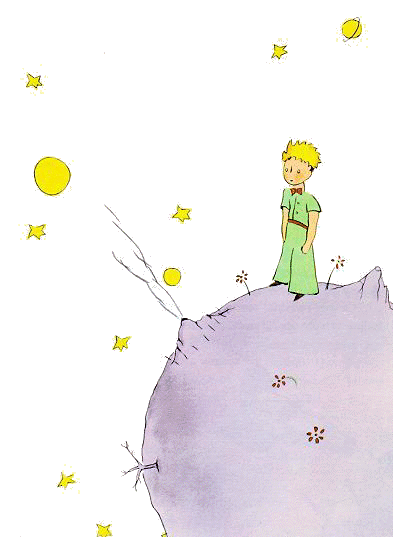
Le Petit Prince - Antoine de Saint Exupéry

Title: The Little Prince (Le Petit Prince)
Author & Illustrator: Antoine de Saint Exupéry  (trans. by Katherine Woods)
Year: 1943
Country: France
Pages: 111
Rating: 4.5 out of 5

The Little Prince is a beautiful children's story narrated by a pilot who crashed in the Sahara Desert. While trying to fix his plane, he meets a little prince from another planet  who asks him to draw a sheep. "When a mystery is too overpowering, one dare not disobey. Absurd as it might seem to me, a thousand miles from any human habitation and in danger of death, I took out of my pocket a sheet of paper and my fountain-pen." (p.8) Thus begins the start of a dialogue in which the little Prince describes his planet, and how he came to Earth.

The Little Prince is a child's view of the world, but it is certainly not for children alone. The story is a remarkable reflection of the human character. I look forward to re-visiting this story with Baby Maya, and to take the time to reflect upon the many metaphors present in this novella.

"And now here is my secret, a very simple secret: It is only with the heart that one can see rightly; what is essential is invisible to the eye." (p.87)

"What makes the desert beautiful," said the little prince, "is that somewhere it hides a well..." (p.93)

Interesting facts about the author:
In 1935, Antoine de Saint Exupéry crashed in the Sahara enroute from Paris to Saigon. He and his companion were rescued 4 days later when a Bedouin on a camel discovered them. This experience is referenced at the beginning of the story.

Tragically, in 1944, one year after The Little Prince was published, Saint Exupéry disappeared while on a reconnaissance mission over the Mediterranean. The remains of his plane weren't found until 1998.

Saturday, March 29, 2008

Gate of the Sun - Elias Khoury

Title: Gate of the Sun
Author: Elias Khoury (translated by Humphrey Davies)
Year: 1998
Country: Lebanon
Pages: 531
Rating: 4 out of 5

First sentence: Umm Hassan is dead.

It is not too often in the Western world that you come across an epic tale about the Palestinian experience. Gate of the Sun, by Lebanese author Elias Khoury, is such a book. 

The story largely takes place in the Shatila refugee camp in Beirut. Khalil, a "temporary doctor, in a temporary hospital, in a temporary country", keeps vigil by the bedside of Yunes, an elderly Palestinian freedom fighter who lies in a coma. In an effort to keep Yunes in this world, Kahlil begins retelling stories of their life of exile in Lebanon, and particularly Yunes' secret visits to his wife, who remained in Israel.

Yunes was a member of the fedayeen, the early Palestinian resistance movement, and much of the story recounts the flight of Palestinians during the late 1940's. However, the heart of the story is not political; it is the story of Yunes' love for his wife Nahilah, and his dangerous border crossings to visit her. It is a story of the mythical, magical world they created in his refuge, the cave Bab al-Shams (Gate of the Sun).

The novel was first published in Arabic in 1998, on the 50th anniversary of The War of Independence, referred to by Palestinians as Al Nakbah (the catastrophe). Mirroring the Arab-Israeli conflict, the story continuously digresses, is retold, and circles back on itself in dizzying fragments. A book about Palestinians, one would assume is also a book about Israelis. However, most of the history portrayed throughout the story traces the meshed history of Lebanon, Palestine, and the way in which Palestinian refugees outside of Israel are treated and viewed by other Arabs. Fortunately, this is not a novel of "us" versus "them", and Khoury humanizes all sides of the struggle that continues to encompass the Middle East.

For those who are regular visitors to my blog, you will notice that my end review is considerably more favorable than my other recent comments on this book. It is a slow, dizzying read. It helps to have a firm knowledge of the Arab-Israeli conflict, and of the Lebanese civil war. Part One of the novel did not capture my attention in the way that the second Part did. In the end, though, I come away highly recommending this novel.

Favorite passages:
"Palestine isn't a cause. Well, all right, in some sense it is, but it isn't really, because the land doesn't move from its place. That land will remain, and the question isn't who will hold it, because it's an illusion to think that land can be held. No one can hold land when he's going to end up buried in it. It's the land that holds men and pulls them back toward it. I didn't fight, my dear friend, for the land or for history. I fought for the sake of a woman I loved. "(p.21)

"Before Umm Hassan could open her mouth to ask a thing, the Israeli woman said, 'It's your house, isn't it?'
'How did you know?' asked Umm Hassan.
'I've been waiting for you for a long time. Welcome.'" (p.104)

"Evil has no meaning, and we were just its tools." (p.271)

"We invent stories of our misery and then believe them. We'll believe anything so as not to see. We cover our eyes and set off, and then we bump into each other." (p. 383)

"It takes another culture to let us discover that half the things that seem obvious are simply our own stupidities." (p.432)

Wednesday, February 27, 2008

The Book Thief - Markus Zusak

Title: The Book Thief
Author: Markus Zusak
Country: Australia
Year: 2005
Pages: 552
Rating: 5 out of 5

First sentence: First the colors.

From the back cover: It is 1939, Nazi Germany. The country is holding its breath. Death has never been busier, and will become busier still.

By her brother's graveside, Liesel Meminger's life is changed when she picks up a single object, partially hidden in the snow. It is The Gravedigger's Handbook, left there by accident, adn it is her first act of book thievery. So begins a love affair with books and words, as Liesel, with the help of her accordion-playing foster father, learns to read. Soon she is stealing books from Nazi book-burnings, the mayor's wife's library, wherever there are books to be found.

But these are dangerous times. When Liesel's foster family hides a Jew in their basement, Liesel's world is both opened up and closed down.

What I thought: I can not come up with the words to describe this book that would do it justice. It is that good. It is written from the unique perspective of Death, a wry, frank, and compassionate character who sees moments in shades of color: The last time I saw her was red. The sky was like soup, boiling and stirring. In some places, it was burned. There were black crumbs, and pepper, streaked across the redness. (p.12). We learn how Death comes to know the book thief and her story. It is an emotionally draining read. 

Towards the end, I was reading parts out loud to my daughter when she was fussy, so that I could calm her down and try to finish the book at the same time. I had to stop, I literally could not read the story out loud without crying. 

There is plenty of foreshadow. I know what is going to happen. I know how it is going to end. And I still sobbed through the last few chapters. Yet, a narrative filled with death and despair, one of the overarching themes is that of hope and love. There is so much love in this story, and overflows from the pages to the reader. 

And, always a favorite for bibliophiles, it is very much a story about words: 

She tore a page from the book and ripped it in half. 
Then a chapter.
Soon, there was nothing but scraps of words littered between her legs and all around her. The words. Why did they have to exist? Without them, there wouldn't be any of this. Without words, the Führer was nothing. There would be no limping prisoners, no need for consolation or wordly tricks to make us feel better. 
What good were the words?
She said it audibly now, to the orange-lit room. "What good are the words?"(p.521)

I was particularly captured by the story within a story - the writings and illustrations of Max, the Jew hidden in the basement. His short story, The Word Shaker, could easily be a stand alone children's book. The book is marketed as young adult fiction, but is just as enjoyable and meaningful for adults.

Favorite quotes:

For now, Rudy and Liesel made their way onto Himmel Street in the rain.
He was the crazy one who had painted himself black and defeated the world. 
She was the book thief without the words.
Trust me, though, the words were on their way, and when they arrived, Liesel would hold them in her hands like the clouds, and she would wring them out like the rain. (p. 80)

I have hated the words and I have loved them, and I hope I have made them right. (p.528)

*** A SMALL PIECE OF TRUTH***
I do not carry a sickle or scythe.
I only wear a hooded black robe when it's cold.
And I don't have those skull-like
facial features you seem to enjoy
pinning on me from a distance. You
want to know what I truly look like?
I'll help you out. Find yourself
a mirror while I continue.
(p. 307)

Tuesday, February 19, 2008

The Translator - Daoud Hari

Title: The Translator: A Tribesman's Memoir of Darfur
Author: Daoud Hari (as told to Dennis Burke and Megan McKenna)
Country: Sudan/USA
Year: 2008
Pages: 200
Rating: 5 out of 5

In 2003, fighting broke out in Darfur as a result of the government's systematic campaign to move non-Arab Sudanese in Darfur off of the oil-rich land. Sudanese government forces and armed militia (known as "Janjaweed") began attacking civilians who are members of the same ethnic groups as the rebels. Countless villages have been destroyed. The rape of women and young girls is used as a tool of war. Hundreds of thousands have died, and over two million people have fled to refugee or IDP (internally-displaced) camps.

Much to my delight, I recently received an ARC of The Translator--a memoir by Daoud Hari, a Sudanese refugee--from one of the marketing managers at Random House.

Daoud Hari, a Zaghawa tribesmen from Darfur, had recently returned to his village after living abroad when his village was attacked by the Janjaweed. He lost his beloved brother, Ahmed, in the attack, but helped his family and many of his relatives and fellow villager cross the desert to reach the relative safety of a border refugee camp.

Daoud Hari is not a person to stand around and do nothing. Despite the danger, he felt compelled to put his English skills to use as a translator for genocide investigators and reporters, in an attempt to get the word out about the genocide, to bring the ethnic cleansing of his people into your living room, so their voices could be heard. His memoir largely follows his work from 2003 until 2006, when he received protection as a refugee in the United States. It is a remarkable story of one man's determination to help his people, risking his life over and over again to fight the injustice that he has witnessed.

Daoud's story is the story of his people. It is also the story of millions of refugees living in border refugee camps around the world. They encounter many of the same problems that Hari witnesses: inadequate shelter, women and girls raped when they have to leave the camp to gather firewood for fuel, and people unable to earn any income when their host country forbids them from working. It is a story that must be read, and that needs to be heard. I believe one of Hari's goals in writing this memoir is to encourage people to take action. It is a lesson I took to heart. Since leaving my work in the refugee field to become a stay-at-home parent, I have wondered how to fill that void. Reading Hari's memoir gave me the impetus I needed to seek out volunteer work with the Stop Genocide Now organization. Thank you, Daoud.

The Darfur genocide is still taking place today. It may come and go in the news, on the whim of large media outlets, but it has not gone away. Ineffective peace agreements often make the situation worse. As Hari points out, as long as the Sudanese government attacks villages or provokes others to do so, there will be more people that join the rebel groups and fight back. In recent months, as predicted, is threatening to create a broader regional instability. In the beginning of this month, fighting broke out on the border regions of Chad and Sudan, threatening refugee camps, as well as the city N'Djamena.

Darfur links:

Recent news:

Wednesday, January 9, 2008

Links - Nuruddin Farah

Title: Links
Author: Nuruddin Farah
Country: Somalia
Year: 2004
Rating: 4 out of 5
Pages: 336

First sentence: "Guns lack the body of human truths!"

It has been 15 years since the Somali state collapsed, when the dictator Said Barre fled Mogadishu in 1991, and Somalia continues to remain a failed state, with no effective government. Continuing to be neglected or ignored by the international community, Somalia has no rule of law or justice system, and very little of its infrastructure remains functioning or intact. As recently as 2006, active warfare broke out between the warlords and militia, with the backing of Ethiopia. This is the setting in which Links takes place, Mogadishu of the mid-1990's. Unfortunately not very different from the Mogadishu of today.

Jeebleh arrives in a Mogadishu vastly different from the one he left twenty years ago. On landing at an airport now under the control of a warlord, Af-Laawe, a man unknown to him that was sent by someone unknown to pick him up, greets Jeebleh with 'Guns lack the body of human truths!' At his hotel, when asking to make an international phone call, he is visited by a one-man phone operator that carries a satellite phone in his bag. Jeebleh does not know what to make of his devastated city, nor how to understand those who live in it. He arrives in Mogadishu with the goal of finding his mother's grave, and finding his friend Bile's niece, who has been abducted. Through Jeebleh's self-righteousness, parallel to the American military intervention, Farah asks the question of how does a person be good and just in a city that is a murderous vacuum.

Links is a psychological quagmire, a reflection of Mogadishu itself. Through Jeebleh's perspective, an exiled Somali now considered an outsider by many of his fellow Somalis that never left the country, we witness the ambiguities of clan violence, hazy alliances, and conflicted values that characterizes the Somali civil war. Through the story of Jeebleh's close friends and acquaintances Farah demonstrates the violence in Mogadishu as a reflection of the disorder in the home, and the impossibility of separating the political from the personal.

This portrayal of tangled clan loyalties and its effect on society is one of the greatest strengths of the novel. His description of war-torn Mogadishu and the personal stories of those whose daily lives are surrounded by such extreme violence, is harrowing and poignant. I was particularly affected by a passage about a mother who describes the day her daughter was permanently injured by an American helicopter:

"I became hysterical," she continued, "and tore at my bare breast, where my daughter had been nursing. I wailed, I wept, I cursed, I prayed, but to no avail. I tore at my clothes, until I disrobed, convinced that my child had been swallowed up in the sand raised by the helicopter's sudden arrival. Then I saw the shape of evil. Rangers pointing at my nakedness and laughing. I stopped wailing, and covered my indecency, and then cursed the mothers who bore these Rangers. I've never glimpsed worse evil than those men cupping their hands at me, their tongues out, pointing at my nakedness." (p.276)
I do wonder why Farah chose English, his 4th language, as the medium to write. At times, the conversations and plot seems awkward, and I leave the novel failing to understand any of the major characters. Despite this weakness, Links remains a telling story of those who have become collateral damage in a cycle of violence.
"A cynic I know says that thanks to the vultures, the marabous, and the hawks, we have no fear of diseases spreading," one of Jeebleh's contacts says. "My cynical friend suggests that when the country is reconstituted as a functioning state, we should have a vulture as our national symbol."

Thursday, December 20, 2007

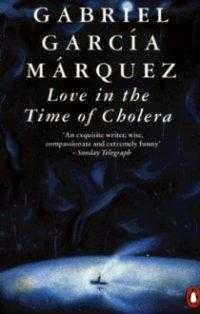
Love in the Time of Cholera - Gabriel Garcia Marquez

Title: Love in the Time of Cholera
Author: Gabriel García Márquez, translated by Edith Grossman
Country: Colombia
Year: 1985
Rating: A-
Pages: 348

There are already some great reviews of this book out there: Eva at A Striped Armchair, Tanabata at In Spring it is the Dawn, Nymeth at Things Mean A Lot, and Chris at Book-A-Rama have all read Love in the Time of Cholera this year.

First sentence: It was inevitable: the scent of bitter almonds always reminded him of the fate of unrequited love.

Challenge book? I read this for the Book Awards Challenge and 2nds Challenge. It was on my list for the Expanding Your Horizons Challenge, but that doesn't start until January so I'm not going to count it.

Short summary: How long would you wait for love? Florentino Ariza is preared to wait 51 years, 9 months, and 4 days. Love in the Time of Cholera is above all a love story set in the late 19th and early 20th century; a story about all the different ways that people can love each other.

What I thought: This novel is in a style completely different from One Hundred Years of Solitude (I would not classify it as a "magical realism" novel), but it retains the lyrical, passionate, and evocative prose that Marquez is so well known for. It is a love story, but it is not only a love story--more of an in-depth look at love and obsession, and how it can change and evolve over a lifetime.

I always love the imagery in many South American novels, and Marquez is one of the masters. I would definitely recommend this book to anyone who likes magical realism, thoughtful prose, and strong character development. It is a book that demands your attention - if you don't have the time to immerse yourself, hold on to it for another day.

Interesting tidbit: In Spanish, el cólera means cholera, but la cólera means choler or anger. If you take this to the extreme, it can be used to describe warfare. In the novel, victims of the civil war are often mistaken for victims of cholera.

From the sky they could see, just as God saw them, the ruins of the very old and heroic city of Cartagene de Indias, the most beautiful in the world, abandoned by its inhabitants because of the cholera panic after three centuries of resistance to the sieges of the English and the atrocities of the buccaneers.

Someone said that cholera was ravaging the villages of the Great Swamp. Dr. Urbino, as he spoke, continued to look through the spyglass.
"Well, it must be a very special form of cholera," he said, "because every single corpse has received the coup de grace through the back of the neck."
-p.226

Tuesday, October 23, 2007

Reading Across Borders Challenge Update

I started this year with a somewhat small challenge, to read one book by an author from another country each month. I decided to expand that, however, to aim for the *slightly* larger long-term goal of reading a book from every country. I am fairly happy with my progress, although I feel some books don't count completely (my choices from Afghanistan, Cuba, China and Cambodia), and I would like to read some works in translation from these countries in the future. In the coming year, I would like to focus on Eastern Europe, the Middle East, and Africa.

I haven't read too many on my list of original 12 books for this year, but I have continued to read books from all over the world. Here is a list of countries I have covered so far, totalling 23. The books that I read this year crossing borders (16 total) are linked to their review:

Africa:
Nigeria: Things Fall Apart by Chinua Achebe; Half of a Yellow Sun and Purple Hibiscus by Chimamanda Ngozi Adichie
South Africa: The Life and Times of Michael K by JM Coetzee; Cry the Beloved Country by Alan Paton; and No Future Without Forgiveness by Desmond Tutu

Asia:
Afghanistan: The Kite Runner and A Thousand Splendid Suns by Khaled Hosseini
Cambodia: First They Killed My Father by Luong Ung
China: Balzac and the Little Chinese Seamstress by Dai Sijie
India: The God of Small Things by Arundhati Roy; Red Earth and Pouring Rain by Vikram Chandra; and The Inheritance of Loss by Kiran Desai (among others)
Israel: A Woman in Jerusalem by A.B. Yehoshua
Japan: I Am A Cat by Soseki Natsume; The Wind-Up Bird Chronicle by Haruki Murakami; The Tale of Genji by Murasaki Shikibu
Russia: Anna Karenina by Leo Tolstoy

Australia/Oceania:
Australia: Illywhacker, The True History of the Kelly Gang by Peter Carey; Dirt Music, Cloudstreet and Blueback: A Fable for all Ages by Tim Winton; Zig Zag Street and Bachelor Kisses by Nick Earls.
New Zealand: The Bone People by Keri Hulme

Europe:
Austria: The Metamorphosis by Franz Kafka
Italy: Foucault's Pendulum by Umberto Eco
Portugal: Blindness by Jose Saramago
United Kingdom: Excellent Women and An Unsuitable Attachment by Barbara Pym (and many others)

North America: (Since I live in the U.S., I don't include any of my readings of US authors in this list)
Canada: Random Passage by Bernice Morgan; Handmaid's Tale, Cat's Eye, Alias Grace, and others by Margaret Atwood (and many more)
Cuba: Dreaming in Cuban by Cristina Garcia
Guatemala: I, Rigoberta Menchu, as told to Elizabeth Burgos-Debray
Mexico: Like Water for Chocolate by Laura Esquival

South America:

Brazil: The Alchemist and By The River Piedra I Sat Down and Wept by Paulo Coehlo
Chile: House of the Spirits, Portrait in Sepia, Daughter of Fortune, and others by Isabel Allende
Colombia: One Hundred Years of Solitude by Gabriel Garcia Marquez

Monday, October 22, 2007

Balzac and the Little Chinese Seamstress - Dai Sijie

Title: Balzac and the Little Chinese Seamstress
Author: Dai Sijie, translated from the French by Ina Rilke
Country: France/China
Year: 2000
Rating: B
Pages: 184 pgs.

First sentence: The village headman, a man of about fifty, sat cross-legged in the centre of the room, close to the coals burning in a hearth that was hollowed out of the floor; he was inspecting my violin.

Short Summary: Two city boys, both sons of intellectuals who have been identified as class enemies during the Cultural Revolution, are sent for re-education in a remote mountain village. There they meet the daughter of a local tailor, and discover a hidden stash of Western classic novels.

Is this a Challenge book? I read this for both the Books to Movies challenge, and my own personal Reading Across Borders challenge. Which leads me to a debate I have been having with myself (aren't those the best kinds of debate?), about how to classify this book. I originally have it listed under my China selection. It is written by a man born in China. But, the novel itself was written in French, 16 years after he left China. So, technically, it could also be considered a French novel, right? Yet, it is a story about China. There are so many books out there written by refugees and other immigrants, this thought keeps coming up in my mind. Hmmm. I've decided to keep Balzac and the Little Chinese Seamstress as my China selection, but may read another book down the line that is translated from the Chinese.

What did I think? On starting this novel, I realized I have read very few books about re-education during the Cultural Revolution, and they have all been non-fiction. Since this is the first time I have come across this topic as the centerpiece of a novel, I was quite excited to dive into the story.

For the most part, it did not disappoint. It is a charming story filled with beautiful imagery and subtle humor. The non-linear storytelling may be a turn-off to some, but I personally enjoy this style. If done well, it keeps the reader on their toes. As the story progresses, however, I started to get the impression that the author began the story almost as an autobiography, introducing a few bits of fiction. But, as the story continues, the fictional aspects grow greater, yet at the same time unrealistic. The resulting effect is a story that feels a bit disjointed and out of tune with itself. However, I still believe the overall power of the story makes it a worthwhile read.

For those who have read it, I am curious what you thought about the ending. That I did not like!

Tuesday, May 29, 2007

Foucault's Pendulum - Umberto Eco

Title: Foucault's Pendulum
Author: Umberto Eco
Country: Italy
Year: 1988
Pages: 641 pgs.
Rating: A

I believe Umberto Eco is the only author I have ever read that can fill a novel with intense intellectual thought, numerous complex theories and treatises, yet still have a well-developed plot and characterization. And, it's a page turner (although the pages do turn a little slower than other books).

I read this book with a dictionary and Internet connection nearby. Yet, I also treasured it's pulpy, film noirish elements (a pulp novel for intellectuals, perhaps?). "The stale, rancid smell of cigarette butts, the ashtrays all brimming. The kitchen sink piled high with dirty dishes, the garbage bin full of disemboweled cans...This was the apartment of a man who had worked nonstop for days without budging, eating only when he had to, working furiously, like an addict." How Eco manages to incorporate pop culture references (Mickey Mouse, Casablanca) into such a novel and make it work, is genius.

Mainly because I studied the theory extensively as a postgrad, I immediately recognized Eco's reliance on postmodernist theory to advance the narrative (post-modernism as the theory that there is no absolute truth; rather, truth is relative to the community we belong to, and to those that hold power). "Official history," the colonel said with a bitter smile, "is written by the victors. According to official history, men like me don't exist." (p.123) -and- "Or is the message really that we should look at everything in a different way" (p.13)

I am surprised this book was a bestseller, and I wonder if all those who bought the book ever got around to starting---and finishing, it. I for one had the book sit on my shelf for 4 years before I was brave enough to open it. And definitely, the first chapter or two are pretty hard to get into. But after that, it was a joy to be in the world of this scholarly detective novel.

Causabon's self-reflection:
"The other evening I had to believe the Plan was true, because if it wasn't, then I had spent the past two years as the omnipotent architect of an evil dream. Better reality than a dream: if something is real, then it's real and you're not to blame." (p.164)

"In those halcyon days I believed that the source of enigma was stupidity. Then the other evening in the periscope I decided that the most terrible enigmas are those that mask themselves as madness. But now I have come to believe that the whole world is an enigma, a harmless enigma that is made terrible by our own mad attempt to interpret it as though it had an underlying truth." (p.95)
Fun Piedmontese expression:
"Ma gavte la nata. Take out the cork." You say to to one who is full of himself, the idea being that what causes him to swell and strut is the pressure of a cork stuck in his behind. Remove it and psssssh, he returns to the human condition." (p.56)

Great Art vs. dime novels:
'Maybe only cheap fiction gives us the true measure of reality... Great Art makes fun of us as it comforts us, because it shows the world as the artists would like the world to be. The dime novel, however, pretends to joke, but then it shows us the world as it actually is - or at least the world as it will become... What has taken place in the real world was predicted in penny dreadfuls.'

Wednesday, May 9, 2007

Like Water for Chocolate

Title: Like Water for Chocolate
Author: Laura Esquival
Country: Mexico
Year: 1990
Rating: B+ Pages: 246 pgs.

I've finally gotten around to reading another book from my Reading Across Borders Challenge. Like Water for Chocolate, by Laura Esquival, is an enchanting story. It's largely a story about Tita, a young woman that grows up near Piedras Negras, as small Mexican town on the edge of the Rio Grande, and close to the US-Mexico border. Tita is forbidden from marrying her true love Pedro due to an outdated family tradition that dictates the youngest daughter must care for her mother until her death. In despair, Pedro marries Tita's older sister in order to be closer to his love. What follows is an adventure in magical realism and gastronomic delights.

This is yet one more book that makes me wish I could read and/or speak fluent Spanish. It's a wonderful story, but I feel I still miss out on something in translation. I absolutely loved the storyline of how her emotions were transmitted through her cooking; the magical power of food. Unfortunately, I did not like Pedro at all. The whole book, I was rooting for Tita to get over her first love. Especially towards the end of the novel, he just seemed too whiny and jealous for his own good.

The first sign of Tita's emotions portrayed through food:
'When she finished beating the meringue, it occurred to Nacha to lick some of the icing off her finger to see if Tita's tears had affected the flavor. No, the flavor did not seem to have been affected; yet without knowing why, Nacha was suddenly overcome with an intense longing. She frosted the cake with the meringue icing as well as she could and went to her room, a terrible aching in her heart. She cried all night, and the next morning she didn't have the strength to help with the wedding.'

Thursday, April 26, 2007

Red Earth and Pouring Rain

Title: Red Earth and Pouring Rain
Author: Vikram Chandra
Year: 1995
Country: India
Rating: B+
Pages: 520 Book From: Personal library (used book sale)

Woohoo! Another Chunkster down the hatch! This is a book in which I truly feel accomplished after finishing, as it had previously been so daunting.

Interesting fact: The title of Vikram Chandra's first novel is taken from a Tamil poem that is amongst the oldest available, dating to approximately 200CE. 'Red Earth and Pouring Rain' refers to the first monsoon rains of the season falling on the dry, parched soil of the red-earthed hills.

Red Earth and Pouring Rain
What could my mother be
to yours? What kin is my father
to yours anyway? And how
Did you and I meet ever?
But in love
our hearts have mingled
as red earth and pouring rain

I first heard of Red Earth and Pouring Rain about three ago, when I spotted it on a friend's bookshelf. A few months later, I nabbed a copy for myself at a used book sale, but since then it has been lingering on my bookshelf. I'm so glad I added it to the Chunkster Challenge, as it is a wonderful book.

Red Earth and Pouring Rain bursts with stories in a language that is powerful and emotional. You are quickly introduced to a dizzying array of characters whose stories are slowly woven together as the novel progresses. At the center of this is Sanjay Paraher, for it is he, once a 19th century Brahmin poet, who has been reincarnated as the typing monkey that is relaying these tales to a captive audience. (Yes, you read that correctly--a typing monkey.)

Rounding out the tales, but not necessarily enhancing the storyline, are the adventures of a young Indian's journey across modern-day America. Many of the characters making an appearance in the novel are based on real historical figures that played a part in the colonizing of India. In the fashion of a true storyteller, you never quite know where you're going to end up. But ultimately, Red Earth and Pouring Rain is a story about redemption.

What brought this novel down a notch is the stories of Abhay, the Indian who went to college in America. It was hard on the senses to be transported from epic battles, Rajput chidren born of magic laddoos, and immortality, to somewhat annoying college students that drive while intoxicated and high on cocaine. I assume there is some sort of symbolic connection between the two stories, but I didn't quite catch it.

How to tell a story properly:
A calm storyteller must tell the story to an audience of educated, discriminating listeners, in a setting of sylvan beauty and silence. Thus the story is perfect in itself, complete and whole. So it has always been, so it must be.
-and-
All stories have in them the seed of all other stories; any story, if continued long enough, becomes other stories, and she is no true storyteller who would keep this from you.

The beginning of colonization in India:
Though cities are often destroyed, sometimes they do not vanish, sometimes they become invisible and invade the hearts and minds of the destroyers, who then live forever changed. So the newcomers and the old ones collided and metamorphosed into a thing wholly new and unutterably old, fell into new orbits around new centres of gravity.

The endurance of hope:
Then they were both quiet, and they walked on, their faces set towards the sunrise, night their sanctuary: in this fragile darkness, delivered of the malignant judgements of reason, the past and present are the same, and the future is lit by the radiant light of hope, and the spirits of your ancestors walk beside you; in the trembling of the earth underneath and the movements of indistinct animals is all the pain of the mother, who loves the universe and makes it well.

Thursday, April 5, 2007

The Inheritance of Loss

Title: The Inheritance of Loss
Author: Kiran Desai
Year: 2006
Pages: 357pgs Rating: B-
Book From: Public library

I have been going through a bit of a reading slump lately, which is why things have been quiet on the blog front. Unfortunately, this book is one of the reasons for that slump. It took me ages to finish reading.

The Inheritance of Loss is set mainly in 1980's India, in the state of West Bengal. With stunning imagery, Desai describes a group of people who, while dwelling in their own personal issues, get caught up in the political turmoil of the region. There is the retired judge, a grumpy man who only seems to have affection of his dog; Sai, the granddaughter who comes to live in the judge's crumbling home after she is killed; Gyan, her tutor and love; and Biju, the son of the cook who makes a go at living illegally in America.

Desai is a beautiful writer, her words jump off the page at you. Yet, somehow, everytime I put the book down, the story quickly became forgettable. After finishing the book, I still don't feel as if I know the characters all that well. I almost felt as if the characters themselves were acting out some part in a play, not their true selves. Their innate psyche remained hidden to me. I honestly can't think of another book I've read that evoked such strong polarities: beautifully written, yet utterly boring (although Saul Bellow's Herzog does come to mind). However, the book did spur some personal research about a part of India I thought I knew a little bit about, and realized I didn't. India is such a large and complex country, I am continually finding new aspects of it. I would love to go back and visit some day, as I have only been to the Tamil Nadu region. I also feel her commentary on post-colonialism was spot on.

On post-colonialism:
"I won't last the month," said Lola. "Almost through," she thumped Bend in the River, "uphill task--"
"Superb writer," said Noni. "First-class. One of the best books I've ever read."
"Oh, I don't know," Lola said, "I think he's strange. Stuck in the past...he has not progressed. Colonial neurosis, he's never freed himself from it. Quite a different thing now. In fact," she said, "chicken tikka masala has replaced fish and chips as the number one take-out in Britain. It was just reported in the Indian Express."

"These white people!" said Achootan, a fellow dishwasher, to Biju in the kitchen. "Sh*t! But at least this country is better than England," he said. "At least they have some hypocrisy here. They believe they are good people and you get some relief. There they shout at you openly in the street, 'Go back to where you came from.'" He had spent eight years in Canterbury, and he had responded by shouting a line Bijue was to hear many times over, for he repeated it several times a week: "Your father came to my country and took my bread and now I have to come to your country to get my bread back."

On prejudice:
This habit of hate had accompanied Biju, and he found that he possessed an awe of white people, who arguably had done India great harm, and a lack of generosity regarding almost everyone else, who had never done a single harmful thing to India.

The first person to climb Mt Everest (and again, commentary on colonialism):
Tenzing was certainly first, or else he was made to wait with the bags so Hilary could take the first step on behalf of that colonial enterprise of sticking your flag on what was not yours...Sherpas went up and down, ten times, fifteen times in some cases, without glory, without claim of ownership, adn there were those who said it was sacred adn shouldn' be sullied at all.