Showing posts with label southern reading challenge. Show all posts

Wednesday, August 15, 2007

Southern Reading Challenge Wrap-Up

The Southern Reading Challenge, hosted by Maggie Reads, was truly a fun challenge. Although it officially wraps up the end of August, I thought I would post a summary of my experience soon after finishing all of the books on my challenge list. The challenge was to read at least three books by Southern authors. I read all three books I had originally set out to read, with a slant towards Southern Classics.

And of course, a great big thank-you to Maggie for hosting this wonderful challenge! I love to read about all the southern writers on her blog, and she definitely made this challenge unique and well worth participating in.

My finished challenge books are:
The Mermaid Chair - Sue Monk Kidd
The Optimist's Daughter - Eudora Welty
To Kill A Mockingbird - Harper Lee

The best book: To Kill A Mockingbird would definitely come out as the lead book. As I had hoped, it completely lived up to its acclaim.

What book could I have done without: I did not like The Mermaid Chair. It certainly did not hold a flame to Kidd's first novel, The Secret Life of Bees, a book I really enjoyed. However, I would still read one of her books if she comes out with a new novel.

Any new authors? This was the first time I had read anything by Eudora Welty, and Harper Lee was also a first.

Books I did not finish: I finished all of the challenge books I set out to read.

What did I learn -- about anything -- through this challenge? I learned that although I thought I was well-read in the Southern Literature genre, I most certainly was not! The challenge helped me to catch up on some classics I had been meaning to read. I also added a LOT of books to my TBR list looking at what other challenge participants were reading. If Maggie would decide to hold this challenge again next year, I would definitely participate, and try to read some of the lesser-known Southern authors.

Monday, August 13, 2007

To Kill A Mockingbird - Harper Lee

Title: To Kill A Mockingbird
Author: Harper Lee
Country: America
Year: 1960
Rating: A
Pages: 323 pgs.

First sentence: When he was nearly thirteen, my brother Jem got his arm badly broken at the elbow.

Finally. I can finally say I have read To Kill A Mockingbird, an achievement that is long, long overdue. I'm not sure how I managed to make it through school without having to read this modern American classic. It was also a delight to read one of the original reviews, About Life & Little Girls, published in Time in 1960.

In Maycomb, Alabama, which is rumored to be based upon Lee's hometown of Monroeville, everybody knows everybody else, and almost everybody is related to you in one way or another. And, as I'm sure many of you are familiar with the unforgettable characters of Scout, Jem, Atticus, and Dill--and the many wonderful neighbors Miss Maudie, Miss Rachel, and the Radleys--I will not rehash the storyline here.

I'm always hesitant to begin a book that I have heard so much about, and To Kill A Mockingbird certainly has its fair share of acclaim. Fortunately, I feel it completely lives up to the hype. I was drawn in to the story from page one, and felt it was a wonderful portrayal of many of this issues going on in the 1930's South: racism, social class differences, Southern chivalry and what that meant at that time, and what courage is.

This was my last book for Maggie's Southern Reading Challenge , and a wonderful note to end it on (I'm also reading it for the Book Awards challenge). To cap it off, I made a quintessential Southern summer dessert. No, not pe-khan pie. :) But the next best thing, a scrumptious peach pie. We picked up a bushel of peaches at the market this weekend, and boy are they good! It was the first time I had ever made a fruit-filled pie. I've always been more of a cook than a baker, and struggle with desserts, but I must say this pie was divine! I had hoped to photograph my very first peach pie, but we, ah, dove into it before I remembered the camera. Ah well, y'all just have to use your 'magination.

More than meets the eye:
'Nobody knew what form of intimidation Mr. Radley employed to keep Boo out of sight, but Jem figured that Mr. Radley kept him chained to the bed most of the time. Atticus said no, it wasn't that sort of thing, that there were other ways of making people into ghosts.' (p. 12)

Simple delights:
'Summer was on the way; Jem and I awaited it with impatience. Summer was our best season: it was sleeping on the back screened porch in cots, or trying to sleep in the treehouse; summer was everything good to eat; it was a thousand colors in a parched landscape; but most of all. summer was Dill.' (p. 38)

On courage:
"I wanted you to see what real courage is, instead of getting the idea that courage is a man with a gun in his hand. It's when you know you're licked before you begin but you begin anyway and you see it through no matter what." (p. 112)

Young love:
'With him [Dill], life was routine; without him, life was unbearable. I stayed miserable for two days.' (p. 132)

Monday, July 16, 2007

Sense of Place Contest

Maggie over at Maggie Reads has added an additional contest to the Southern Reading Challenge. She asks readers to pick a passage from one of our challenge books that depicts a sense of place, and post a picture along with that passage.

I decided to select a passage from The Optimist's Daughter (linked to my review). Although a large part of the book takes place in the main characters' hometown, Mount Salus, Mississippi, I chose a different location that Eudora Welty captured perfectly. The following passage depicts the train journey that Laurel and her step-mother took after the death of Judge McKelva, returning from New Orleans to Mount Salus.

"Set deep in the swamp, where the black trees were welling with buds like red drops, was one low beech that had kept its last year's leaves, and it appeared to Laurel to travel along with their train, gliding at a magic speed through the cypresses they left behind. It was her own reflection in the windowpane--the beech tree was her head. Now it was gone. As the train left the black swamp and pulled out into the space of Pontchartrain, the window filled with a featureless sky over pale smooth water, where a seagull was hanging with wings fixed, like a stopped clock on the wall." (p. 45)
Causeway over Lake Pontchartrain

Sunday, July 15, 2007

The Optimist's Daughter - Eudora Welty


Title: The Optimist's Daughter
Author: Eudora Welty
Country: America (south)
Year: 1972
Rating: B+
Pages: 180 pgs

"Never think you've seen the last of anything" - Eudora Welty (she died on July 23, 2001)

First sentence (and second sentence, because I really like it): A nurse held the door open for them. Judge McKelva going first, then his daughter Laurel, then his wife Fay, they walked into the windowless room where the doctor would make his examination.

The Optimist's Daughter is a character-driven rather than a plot-driven story. Therefore, a quick summary of the plot does not do it justice. The majority of what makes the novella a good read is hidden below the surface, as Welty explores issues including love, loss, memory and the passage of time. Although short, it is not an easy read, and is best read at leisure, absorbing the words rather than scanning them.

One of the overarching themes of the novel is individual human memory; a reminder that memory is a living thing, and is itself subject to transit. The confluence of human memory is alluded to in the following passage, a memory that Laurel recalls of returning to Mount Salus with her husband:

"When they were climbing the long approach to a bridge after leaving Cairo, rising slowly higher until they rode above the tops of bare trees, she looked down and saw the pale light widening and the river bottoms opening out, and then the water appearing, reflecting the low, early, sun. There were two rivers. Here was where they came together. This was the confluence of the waters, the Ohio and the Mississippi...And they themselves were a part of the confluence. Their own joint act of faith had brought them here at the very moment and matched its occurrence, and proceeded as it proceeded. Direction itself was made beautiful, momentous." (p.159)
My only complaint with the novella was that I could never get a full sense of the characters. When I reached the last page, I wished that I knew and understood them better, particularly Laurel. The end was unsatisfying, and I longed to know more. Of course, this could have been Eudora Welty's intent.

A metaphor on the persistence of memories:
"It [the bird] could not get in here. But had it been in already? For how long had it made free of the house, shuttling through the dark rooms? And now Laurel could not get it out." (p.129)
Creating the perfect southern scene:
"Laurel, kneeling, worked among the iris that still held a ragged line along the back of the house up to the kitchen door...Her callers sat behind her and over to the side, in the open sunshine. These four elderly ladies were all at home in the McKelva backyard. Cardinals, flying down from low branches of the dogwood tree, were feeding here and there at the ladies' crossed feet. At the top of the tree, a mockingbird stood silent over them like a sentinel." (p.105)


Sunday, June 17, 2007

Beach Reads

After a leisurely week at the beach, I was able to finish three of the five books that I took with me down to Hilton Head, South Carolina.

Title: They Do It With Mirrors (or, Murder with Mirrors in America)
Author: Agatha Christie
Country: Britain
Year: 1952
Rating: B+
Pages: 207 pgs.

First sentence: Mrs. Van Rydock moved a little back from the mirror and sighed.

What can I say about Agatha Christie? It is always a delight to delve into one of her mysteries, particularly those involving the always entertaining Miss Marple. Set in an unkempt British mansion which has largely been converted into a philanthropic project for juvenile delinquents, Miss Marple is visiting an old school friend when murder and mayhem appear in the well-to-do family. An amazing number of suspects leads to an interesting mystery in which Miss Marple, as always, keeps one step ahead of the local police investigators. Not her best work, but still a charming novel.

Title: The Mermaid Chair
Author: Sue Monk Kidd
Year: 2005
Rating: C-
Pages: 335 pgs.

First sentence: In the middle of my marriage, when I was above all Hugh's wife and Dee's mother, one of those unambiguous women with no desire to disturb the universe, I fell in love with a Benedictine monk.

The Mermaid Chair was in theory a great pick to read as I sat on the beach, luxuriating in the sun. The story took place on fictional Egret Island, in which I recognized many characteristics of the South Carolina low country sea islands, especially such islands as Bull Island and Daufuskie. It also made me pine for what Hilton Head island must have been like before the bridge was built and the wealthy descended (can you tell I am not a fan of the island in its current state?).

Unfortunately, the story fell far short of its predecessor, The Secret Life of Bees. The Mermaid Chair, in its simplest form, is the story of Jessie's mid-life search for her lost identity and individualism, and a return to her family and roots on the island that she fled from after her father was killed in a boating accident.

The story had an extremely slow start. Jessie's affair with an almost-monk is unbelievable and borders on drivel; the characterizations were horrendous and barely readable; the plot twisted and turned in ways that were not quite entertaining. The only redeeming quality to the book, which garnered my slightly below average rating, was the description of the landscape. There were small moments when the authors talent really shined through. Too bad it was hidden below so many layers of disappointing hodgepodge.

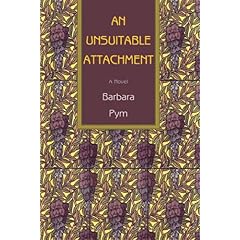
Title: An Unsuitable Attachment
Author: Barbara Pym
Country: Britain
Year: 1982
Rating: A-
Pages: 207 pgs.

First sentence: They are watching me, thought Rupert Stonebird, as he saw the two women walking rather too slowly down the road.

This is the second book I have read by Barbara Pym. After reading Excellent Women a few years ago and really enjoying it, I wasn't too sure what to expect from her other books. An Unsuitable Attachment is a quiet, simple story about rather ordinary, well-to-do gentlemen and women going about life in St Basil's parish, set in a not very fashionable quarter in London, I believe sometime around the 1960's. Pym is very adept at describing the social conventions and mores of her own time and socio-economic class, which is what draws me to her novels. It was an enjoyment to become acquainted with the characters in the novel: Mark and Sophia Ainger, the parish vicar and his wife, who treats their cat Faustina like a spoiled child; Ianthe, a "middle-age" woman on her way to becoming a spinster until fate intervenes; Rupert Stonechild, an anthropologist who has certainly never studied or understood the wishes and desires of British women; and many others. Overall, a charming novel.

Sunday, April 22, 2007

Southern Reading Challenge

June 1 - August 31

One of my favorite genres, joining this challenge hosted by Maggie over at Maggie Reads was a no brainer.
Here is my selection of three southern books:
1. To Kill A Mockingbird - Harper Lee
2. The Optimist's Daughter - Eudora Welty
3. The Mermaid Chair - Sue Monk Kidd

I figured it was about time I got around to reading To Kill A Mockingbird. It is long, long, long overdue! Eudora Welty's The Optimist's Daughter has been sitting on my bookshelf for one year now. I had decided to delve into her writings, and picked up this book at a used book store...and then never got around to reading it. Now's the time! The third book is more of a fluff read, and may change before the challenge starts. I will be going down to Hilton Head Island for a vacation in June, and was hoping to find a novel whose setting is Hilton Head Island (prior to all of the upscale development), or Savannah, Georgia. No luck however, in finding a book that I haven't already read.