Pride and Prejudice - Jane Austen
"I am not in the habit of being disappointed!""That will make your ladyship's position more pitiable; but it will have no effect upon me." (p.303)
"Words are the voice of the heart." - Confucius. This place is for me, and you, to revel in the art of the written word. So pull up that hot pot of tea, coffee, or mulled cider, a comfy chair, a good book, and maybe a cat or two and join my bibliophilia!
"I am not in the habit of being disappointed!""That will make your ladyship's position more pitiable; but it will have no effect upon me." (p.303)
Scribed by
Nyssaneala
at
8:43 AM
32
reader's responses
Labels: British Lit, classics, literature, women writers, world lit
Scribed by
Nyssaneala
at
7:22 AM
4
reader's responses
Labels: classics, european lit, literature, reading across borders, world lit
Title: Chéri and The Last of Chéri
Chéri never forgot their nocturnal journey home, the sadness of the lingering crimson in the west, the smell of the grasses, the feathery moths held prisoner in the beam of the headlamps. (p.167)She put back the receiver, showing nothing but the curve of her back. As she moved away, she inhaled and exhaled puffs of blue smoke, and vanished in the midst of her cloud like a magician whose task is accomplished. (p. 181)
Scribed by
Nyssaneala
at
3:50 PM
3
reader's responses
Labels: classics, french lit, reading across borders, women writers, world lit
Title: Great Expectations
Author: Charles Dickens
Country: Britain
Year: 1861
Rating: 5 out of 5
Pages: 484
First Sentence: My father's family name being Pirrip, and my christian name Philip, my infant tongue could make of both names nothing longer or more explicit than Pip.
I have only read Dickens once before, an that was not of my own volition. I read A Tale of Two Cities in 10th grade, and really loved it. For some reason, I never went back. I always meant to, and when My Year of Reading Dangerously came about at Estella's Revenge, and Great Expectations was January's book, I figured I couldn't put it off any longer.
I will admit, it was a slow start. For the first 50 pages or so, I wasn't entirely captivated. Then I really became interested and engaged with the characters, particularly Miss Havisham, and thoroughly enjoyed the rest of the novel.
As many of you probably know, since Great Expectations started out as a weekly serial, there is never a lack of suspense. Dickens' writing is intricate and detailed, and there are more twists and turns than many of the other books I have read from his time period. His ability to hone in on the nuances of human behaviour, particularly through Pip's fallibility, is a highlight in what I consider to be a true masterpiece. Great Expectations covers virtually every aspect of the human condition, and causes the reader to consider their own human nature and "great expectations". Highly Recommended.
So throughout life, our worst weaknesses and meannesses are usually committed for the sake of the people whom we most despise. (p.218)
Scribed by
Nyssaneala
at
2:12 PM
7
reader's responses
Labels: British Lit, classics, european lit, year of reading dangerously
Title: To the Lighthouse
Author: Virginia Woolf
Country: British
Year: 1927
Rating: A-
Pages: 310
First sentence: "Yes, of course, if it's fine tomorrow," said Mrs. Ramsey.
Short summary: This novel takes place in three parts taking place at the summer home of an English family, the Ramseys, in the Hebrides. The first part takes place over one afternoon and evening; the second spans ten years in which the home is left unoccupied; and the third part is a morning after the ten years in which some of the original characters return to the Ramsey's summer home.
Is this for a challenge? I decided to substitute this novel for Orlando by Virginia Woolf in the TBR challenge. Both have been on my bookshelf for a very long time. I also read it for the Seconds challenge.
What I thought: Virginia Woolf is not an easy read. But she is a delight. To the Lighthouse is written in a similar stream-of-consciousness style as Mrs Dalloway (reviewed here). However, Mrs Dalloway is mostly all about Clarissa: her relation to others, and others' (servants, family, friends) in relation to her. To the Lighthouse is more a story of the interrelationships amongst a group of people, and delves into the psychology of imagination and emotion from a variety of perspectives (albeit, some of the characters are not very interesting). It is not a novel to be read for its plot. The main focus of the story is on the inner workings of the people we meet. The third section of the novel seems to drift about, and I am left wondering if this is an unintentional weakness, or a hidden purpose that shows how things can fall apart.
It may help to have a broader knowledge of Virginia Woolf's work and career, to begin to capture and understand the larger artistic aims of this novel. As I discovered with Mrs Dalloway, Woolf's novels are best enjoyed at a leisurely pace. It is another book that I hope to come back to again someday.No, she said, she did not want a pear. Indeed she had been keeping guard over the dish of fruit (without realizing it) jealously, hoping that nobody would touch it. Her eyes had been going in and out among the curves and shadows of the fruit, among the rich purples of the lowland grapes, then over the horny ridge of the shell, putting a yellow against a purple, a curved shape against a round shape, without knowing why she did it, or why, every time she did it, she felt more and more serene; until, oh, what a pity that they should do it--a hand reached out, took a pear, and spoilt the whole thing. (p.163)
Scribed by
Nyssaneala
at
2:12 PM
10
reader's responses
Labels: British Lit, classics, european lit, fiction, literature, seconds challenge, women writers
Title: To Kill A Mockingbird
Author: Harper Lee
Country: America
Year: 1960
Rating: A
Pages: 323 pgs.
First sentence: When he was nearly thirteen, my brother Jem got his arm badly broken at the elbow.
Finally. I can finally say I have read To Kill A Mockingbird, an achievement that is long, long overdue. I'm not sure how I managed to make it through school without having to read this modern American classic. It was also a delight to read one of the original reviews, About Life & Little Girls, published in Time in 1960.
In Maycomb, Alabama, which is rumored to be based upon Lee's hometown of Monroeville, everybody knows everybody else, and almost everybody is related to you in one way or another. And, as I'm sure many of you are familiar with the unforgettable characters of Scout, Jem, Atticus, and Dill--and the many wonderful neighbors Miss Maudie, Miss Rachel, and the Radleys--I will not rehash the storyline here.
I'm always hesitant to begin a book that I have heard so much about, and To Kill A Mockingbird certainly has its fair share of acclaim. Fortunately, I feel it completely lives up to the hype. I was drawn in to the story from page one, and felt it was a wonderful portrayal of many of this issues going on in the 1930's South: racism, social class differences, Southern chivalry and what that meant at that time, and what courage is.
This was my last book for Maggie's Southern Reading Challenge , and a wonderful note to end it on (I'm also reading it for the Book Awards challenge). To cap it off, I made a quintessential Southern summer dessert. No, not pe-khan pie. :) But the next best thing, a scrumptious peach pie. We picked up a bushel of peaches at the market this weekend, and boy are they good! It was the first time I had ever made a fruit-filled pie. I've always been more of a cook than a baker, and struggle with desserts, but I must say this pie was divine! I had hoped to photograph my very first peach pie, but we, ah, dove into it before I remembered the camera. Ah well, y'all just have to use your 'magination.
More than meets the eye:
'Nobody knew what form of intimidation Mr. Radley employed to keep Boo out of sight, but Jem figured that Mr. Radley kept him chained to the bed most of the time. Atticus said no, it wasn't that sort of thing, that there were other ways of making people into ghosts.' (p. 12)
Simple delights:
'Summer was on the way; Jem and I awaited it with impatience. Summer was our best season: it was sleeping on the back screened porch in cots, or trying to sleep in the treehouse; summer was everything good to eat; it was a thousand colors in a parched landscape; but most of all. summer was Dill.' (p. 38)
On courage:
"I wanted you to see what real courage is, instead of getting the idea that courage is a man with a gun in his hand. It's when you know you're licked before you begin but you begin anyway and you see it through no matter what." (p. 112)
Young love:
'With him [Dill], life was routine; without him, life was unbearable. I stayed miserable for two days.' (p. 132)
Scribed by
Nyssaneala
at
8:27 PM
6
reader's responses
Labels: american lit, book awards challenge, classics, southern reading challenge, women writers

Title: The Optimist's Daughter
Author: Eudora Welty
Country: America (south)
Year: 1972
Rating: B+
Pages: 180 pgs
"Never think you've seen the last of anything" - Eudora Welty (she died on July 23, 2001)
First sentence (and second sentence, because I really like it): A nurse held the door open for them. Judge McKelva going first, then his daughter Laurel, then his wife Fay, they walked into the windowless room where the doctor would make his examination.
The Optimist's Daughter is a character-driven rather than a plot-driven story. Therefore, a quick summary of the plot does not do it justice. The majority of what makes the novella a good read is hidden below the surface, as Welty explores issues including love, loss, memory and the passage of time. Although short, it is not an easy read, and is best read at leisure, absorbing the words rather than scanning them.
One of the overarching themes of the novel is individual human memory; a reminder that memory is a living thing, and is itself subject to transit. The confluence of human memory is alluded to in the following passage, a memory that Laurel recalls of returning to Mount Salus with her husband:
"When they were climbing the long approach to a bridge after leaving Cairo, rising slowly higher until they rode above the tops of bare trees, she looked down and saw the pale light widening and the river bottoms opening out, and then the water appearing, reflecting the low, early, sun. There were two rivers. Here was where they came together. This was the confluence of the waters, the Ohio and the Mississippi...And they themselves were a part of the confluence. Their own joint act of faith had brought them here at the very moment and matched its occurrence, and proceeded as it proceeded. Direction itself was made beautiful, momentous." (p.159)My only complaint with the novella was that I could never get a full sense of the characters. When I reached the last page, I wished that I knew and understood them better, particularly Laurel. The end was unsatisfying, and I longed to know more. Of course, this could have been Eudora Welty's intent.
"It [the bird] could not get in here. But had it been in already? For how long had it made free of the house, shuttling through the dark rooms? And now Laurel could not get it out." (p.129)Creating the perfect southern scene:
"Laurel, kneeling, worked among the iris that still held a ragged line along the back of the house up to the kitchen door...Her callers sat behind her and over to the side, in the open sunshine. These four elderly ladies were all at home in the McKelva backyard. Cardinals, flying down from low branches of the dogwood tree, were feeding here and there at the ladies' crossed feet. At the top of the tree, a mockingbird stood silent over them like a sentinel." (p.105)
Scribed by
Nyssaneala
at
9:03 PM
9
reader's responses
Labels: american lit, book awards challenge, classics, fiction, southern reading challenge, women writers
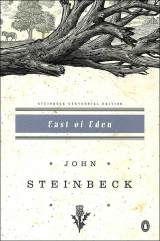
Title: East of Eden
Author: John Steinbeck
Country: America
Year: 1952
Rating: A
Pages: 567 pgs.
First sentence: The Salinas Valley is in Northern California.
To Steinbeck, there was only "one story in the world" (Ch. 34), the story of good and evil. East of Eden is his allegory of that story, and as its title suggests, he believed that story went all the way back to the beginning of mankind. In many ways it parallels the story of Cain and Abel. It is the story of the intertwining of two families, the Trasks and the Hamiltons. The settling and development of the Salinas Valley acts as a third story line, as Steinbeck describes the Valley in rich and vivid descriptions throughout the novel.
I remember that the Gabilan Mountains to the east of the valley were light gay mountains full of sun and loveliness adn a kind of invitation, so that you wanted to climb into their warm foothills almost as you want to climb into the lap of a beloved mother...The Santa Lucias stood up against the sky to the west and kept the valley from the open sea, and they were dark and brooding - unfriendly and dangerous. I always found in myself a dread of west and a love of east. (p.7)
East of Eden is filled with rich, complex characters. Some of my favorites are Samuel Hamilton, an institution in Salinas and the person through which Steinbeck disperses much of his commentary on human nature. Lee, is Adam Trasks' intellectual Chinese-American servant whom uses pidgin English with strangers because they understand him better than when he speaks fluent English. And then there is Cathy [aka Kate]. I believe there are monsters born in the world to human parents. Some you can see, misshapen and horrible...They are accidents and no one's fault, as used to be thought. Once they were considered the visible punishment for concealed sins. And just as there are physical monsters, can there not be mental or psychic monsters born? The face and body may be perfect, but if a twisted gene or malformed egg can produce physical monsters, may not the same process produce a malformed soul? (p. 72) Cathy Ames is the most complex and evil woman in the history of literature (that I have read). She is fascinating and repulsive all at once.
I was first captivated by East of Eden as a teenager, so it was interesting to go back and read the novel after 12 years (as I did with Grapes of Wrath in March). The first time I read the story, everything seemed a little larger than life. The second time around a twinge of tediousness set in here and there, but I was more fully able to understand and appreciate many of the universal themes I skimmed over the first time around. I still consider East of Eden as a masterpiece, standing beside Grapes of Wrath and other novels by Steinbeck.
East of Eden Trivia:
- Steinbeck kept a journal of daily letters to his publisher, that document the writing of his most difficult and personal work. It is now published as Journal of A Novel: The East of Eden Letters.
- Steinbeck acts as both the narrator of the story, and places himself and his family in the novel as minor characters. His mother, Olive Hamilton, is a daughter of Samuel Hamilton. One of the most amusing stories in the novel is the telling of how Olive won a plane ride for selling Liberty Bonds during the war.
This book marks my completion of the Chunkster Challenge. Yay!
Scribed by
Nyssaneala
at
11:35 AM
9
reader's responses
Labels: american lit, chunkster challenge, classics, fiction
Title: The Grapes of Wrath
Author: John Steinbeck
Year: 1939 Pages: 473pgs
Rating: A
Book From: Personal collection (originally my father's)
Scribed by
Nyssaneala
at
2:05 PM
6
reader's responses
Labels: american lit, chunkster challenge, classics, historical fiction
Mrs Dalloway
Author: Virginia Woolf
Pages: 225 pgs.
Rating: A
Written in 1925, Mrs Dalloway is largely about one day in the life of Clarissa Dalloway, as she plans for her party that night. We also learn about the last day in the life of Septimus Smith, a shell-shocked war veteran descending into madness and contemplating suicide. As much as the story is about Clarissa, it is also about Septimus and his suicide.
The reader learns much about Mrs Dalloway—her innermost thoughts, her past, her position in society, and how her friends and acquaintances view her. We learn very little about Septimus. Mrs Dalloway and Septimus never meet, although their lives do intersect in ordinary and seemingly meaningless ways. Virginia Woolf suggests in her diaries that Septimus “might be left vague—as a mad person is—not so much a character as an idea.”
This book was a tough start. My mind wandered. I daydreamed. I lost track of what was happening in the stream-of-consciousness style that Woolf utilizes. About halfway through the novel, I put it down for a breather. Then, a few minutes later, I re-opened the book at page one. Why did I do that? I really wanted to give the book a second chance. I’m glad I did. By changing my reading style I was able to enjoy the story more. I purposely slowed my reading pace, and did not hesitate to re-read passages over and over. And eventually, I made it to the end! It’s been a long time since I felt such achievement over finishing a book.
Overarching the somewhat drab story-line is a highly-charged commentary about the politics of the Great War (WWI), an empire entering decline, and the make-up of a society and people in power. One thing Woolf does amazingly well is bring London of that time to life. I can hear the hourly toll of Big Ben, listen and smell the back-fire of a motor car on Bond Street, see the afternoon tea held at Lady Bruton’s. Using a slight hand of satire, the group that gathers at Mrs Dalloway’s party is not a group that you would confidently leave in charge of a nation.
On the tolling of Big Ben (used repeatedly throughout the novel, heard by numerous characters):
“First a warning, musical; then the hour, irrevocable. The leaden circles dissolved in the air.”
On women:
“She had the oddest sense of being herself invisible, unseen; unknown; there being no more marrying, no more having of children now, but only this astonishing and rather solemn progress with the rest of them, up Bond Street, this being Mrs Dalloway; not even Clarissa any more; this being Mrs. Richard Dalloway.
Why Septimus fought in the Great War:
“Septimus was one of the first to volunteer. He went to France to save an England which consisted almost entirely of Shakespeare’s plays and Miss Isabel Pole in a green dress walking in a square.”
Interesting facts:
- In Mrs Dalloway, Virginia Woolf documents the first demonstration of skywriting, which occurred over London in 1922.
- Examples of Woolf’s grappling with mental illness are characterized in Septimus’ madness, such as when he hears sparrows singing to him in Greek.
- The British suffrage movement obtained the right to vote for women over 30 in 1918. It was not until 1928 that it was extended to women aged 21 to 29.
Music I listened to while reading Mrs Dalloway:
- The 1920’s Radio Network Live Stream: http://www.the1920snetwork.com/ (If you have a Mac, its readily available in the Radio section of iTunes)
- The composer Wagner, a favorite of the character Peter Walsh.
Scribed by
Nyssaneala
at
1:51 PM
5
reader's responses
Labels: British Lit, classics, fiction, women writers
The Metamorphosis (including critical essays)
Author: Franz Kafka
Translator: Stanley Corngold
Pages: 194pgs.
Rating: B
More than anything, Metamorphosis by Franz Kafka has given society a healthy debate. Never truly explaining his work, Kafka has left academics and inquiring readers alike pondering the meaning of his stories. Metamorphosis is no different.
Taken at face value, Kafka presents a simple story. The first sentence sets the mood and theme for the entire story: “When Gregor Samsa woke up one morning from unsettling dreams, he found himself changed in his bed into a monstrous vermin.” Gregor becomes an insect, and the rest of the short story describes how he lives out the rest of his life. All philosophical pandering is ultimately left to the masses.
Kafka does not explain why the Metamorphosis occurred. Nor does he give any inkling to the depths of the story, its symbolism, and deeper meaning. In this vacuum, numerous theories have been developed ranging from Freudian interpretations, religious symbology and connotations, and Marxist attacks on the “bourgeois condition”. Many do not even agree on an accurate English translation for the title, and would rather see it changed to a variety of options, ranging from Transformation to Transubstantiation.
Is it an existential novel? Maybe. Is it a simple story? Maybe. Eighty years of analysis have not been able to answer these questions, I’m not about to try. Why such pressure to give a story one true meaning? If 50 people are affected by Metamorphosis in 50 different ways – more power to Kafka!
Did I like this story? Maybe. It’s honestly hard to say. Was it worth reading? Definitely. I already feel as if this is a story that will stick with me for a long time. When I least expect it, it will pop back into my subconscious, looking to be explored.
What did I think? I’m not telling. ☺ At least, not yet.
Some interesting quotes:
"Gregor tried to imagine whether something like what had happened to him today could one day happen even to the manager; you really had to grant the possibility."
"Unfortunately the manager's flight now seemed to confuse his father completely, who had been relatively calm until now, for instead of running after the manager himself, or at least not hindering Gregor in his pursuit, he seized in his right hand the manager's cane, which had been left behind on a chair with his hat and overocoat, picked up in his left hand a heavy newspaper from the table, and stamping his feet, started brandishing the cane and the newspaper to drive Gregor back into his room. No plea of Gregor's helped, no plea was even understood; however humbly he might turn his head, his father merely stamped his feet more forcefully."
"In the beginning she [cleaning woman] also used to call him over to her with words she probably considered friendly, like 'Come over here for a minute, you old dung beetle!' or 'Look at that old dung beetle!' To forms of address like these Gregor would not respond but remained immobile where he was, as if the door had not been opened."
Up next is D for Deadbeat, some cozy mystery reading to relax with (but most likely will not review). Then its back to the teens and twenties of the 20th century, with Virginia Woolf's Mrs Dalloway.
Scribed by
Nyssaneala
at
1:07 PM
4
reader's responses
Labels: austro-german lit, classics, european lit, reading across borders