Monday, July 2, 2007

We're having a girl!


We saw our first glimpse of our little baby Maya or Eliana on Friday, which was very exciting. An extremely active little one--training for that triathlon already, perhaps---it was difficult to get profile shots of her as she was constantly moving around. A fact which I already knew, since I feel her moving all the time!

However, we did get quite a few face shots before her shyness overcame her, and she covered her face with her arms. It was quite a joy too see the little things: her heartbeat, seeing her swallow, and moving her legs about. Our midwife referred us to a wonderful doctor for the u/s, helped by the fact that he completed his residency at the same hospital my husband is currently at. Therefore, he spent loads of time with us, explaining everything to me (with ongoing commentary from dear hubby), and trying to get a "cute" photo. :)

The one on the right is using 4D technology. So she looks a bit alienish, but you can at least pick out the face easily! Apparently, she has long arms and legs. I hope that's not a sign of things to come, as I'm only 5'1, but Aaron's grandfather was over 6 feet tall!

Wednesday, June 27, 2007

The Great Harry Potter Re-Read, Part 1


The countdown here has begun. I have just started my re-read of all six Harry Potter book prior to the release of Harry Potter and the Deathly Hallows on July 21. Most of the books I have only read once, so I thought the best way to usher in the final installment was to reacquaint myself with Harry, his friends, and the Hogwarts world.

In lieu of recaps, I thought I would post some random trivia about each book.

Random Trivia about Harry Potter and the Philosopher's Stone
(aka Harry Potter and the Sorcerer's Stone)

1. Missing text - American readers are introduced to Gryffindor House member Dean Thomas before their British counterparts. The American edition retains the following text that was edited out of the British edition: "Thomas, Dean," a Black boy even taller than Ron, joined Harry at the Gryffindor table.
Note: When I read this sentence in the novel, I also wondered why black was capitalized.

2. Word Count: The first book contains 76,944 words.

3. Title: Refers to a stone sought after by alchemists, a stone which was reputed to turn other metals into gold and to grant immortality.

4. Cover art: You can go here to see Harry Potter cover art from all over the world. The original Bloomsbury cover by Thomas Taylor includes a rather bizarre-looking figure on the back. The man in the picture really doesn't match any character in the book, although fans have speculated that it is supposed to represent eitherDumbledore or Quirrell. After a few editions, the back cover was changed with a new image, this time clearly identifiable as Dumbledore, even holding a Put-Ouer. [source here.]

Iranian Cover Art

Tuesday, June 26, 2007

Nickel and Dimed

Title: Nicked and Dimed: On (Not) Getting By In America
Author: Barbara Ehrenreich
Country: America
Year: 2001
Rating: B
Pages: 221 pgs

First sentence: Mostly out of laziness, I decided to start my low-wage life in the town nearest to where I actually live, Key West, Florida, which with a population of about 25,000 is elbowing its way up to the status of a genuine city.

In Nickel and Dimed, which I read for the Non-fiction and TBR challenges, Barbara Ehrenreich goes 'undercover', spending a few months working in various cities as part of the working poor population, one of the most disenfranchised groups in America. For a short period of time, she gives up fancy restaurants, a large home, and other measures of comfort to see what life might be like after welfare reform. What she finds, which certainly isn't news to a lot of people, is that it is exceedingly difficult to get by on a low-wage job ($6-10/hr) in an economy filled with skyrocketing housing cost and other barriers. It is a poignant portrayal of the problems facing those who help keep the middle and upper classes comfortable: gas station attendants, fast food workers, Wal-Mart employees, house cleaners, nannies, janitors.

Ehrenreich raises some very important points in her book, which is one reason I gave it a fairly decent rating. She discovers, and criticizes a state of affairs in which subsidized, low-cost housing to become so scarce that many full-time workers are homeless (here in Baltimore, it's at least a two-year waiting list for subsidized housing). She documents the daily tribulations of retail, housecleaning, and restaurant workers: daily humiliation from management, the inability to take time off for illness without docking pay, recriminations for promoting unions, company health insurance that is still unaffordable, etc. She brings to the mainstream an oppressive situation that has been festering for years.

I am personally familiar with a lot of the working conditions that Barbara faced, as I have worked at one time or another as a Sales Associate, restaurant server, and 'nurse's aide' (for lack of a better term) during college, and for quite a while afterwards. Fortunately, I had a support system in which I was able to get by on the wages that I earned (and a boyfriend that received money for rent through his med student loans).

With this familiarity, comes one of my chief complaints. Barbara barely spent two-three weeks at most of the jobs that she tried out, and sometimes lasted quite a bit less. She stayed in 3 cities for no more than a month at a time. Unrealistically, at no time did she accept help from others when it was offered, or attempt to make things easier by having a roommate or carpooling to work. She did not attempt to socialize with any of her co-workers after hours.

I feel there was a huge lost potential in this project, and wish she would have committed to it for a longer period of time. I also felt there was a certain arrogance that reared it's head, an almost 'if I can't do this, how can anyone else' mentality. "I am, of course, very different from the people who normally fill America's least attractive jobs." (p.6) With more time, she could have explored the effects of working [two jobs] with a reliance on public transportation, and all of the problems that this can cause (a job that starts before public transport does, services that are always late, etc--can you tell that I have been there, done that!). She also failed to explore an important issue that accompanies a lack of subsidized housing--the fact that the working poor are often forced to live in substandard, housing conditions that are dangerous and usually located in neighborhoods that have much higher rates of violent crime and drug trafficking.

Nickel and Dimed highlights a lot of sobering statistics about low wage earners and the living conditions they are forced into. I have dug around for some similar, but updated statistics:
- 15% of those who are homeless are employed in full-time work (National Coalition for Homelessness, 2005)
- 5.6 million people (4% of the workforce) currently earn less than $7.25/hour. More than half of those workers are engaged in full-time work.
- 59% of workers who would benefit from a minimum wage increase are women.

Monday, June 25, 2007

Chunkster Challenge Wrap-Up

The Chunkster Challenge, hosted by Bookfoolery and Babble, is the most challenging of the challenges I have participated in this year. The challenge was to read as many chunksters (over 400 pages) as you choose from January 1 through June 30. I chose to read five, and successfully read four of my original choices and one alternate. I did not finish one book.

My finished challenge books are:
The Wind-Up Bird Chronicle - Haruki Murakami
Red Earth and Pouring Rain - Vikram Chandra
Grapes of Wrath - John Steinbeck
Foucault's Pendulum - Umberto Eco
Alternate:
East of Eden - John Steinbeck

However, I also read 8 other books that fit the criteria as a Chunkster. And one that fell one page short at a mere 399 pages.

The best book: That is really hard, as I loved them all. If I had to choose one, I guess it would be East of Eden by John Steinbeck.

What book could I have done without: The only book I could have done without is the one I did without. I did not finish The Fountainhead by Ayn Rand, which was on my original list. It was horrible.

Any new authors? Yep, Vikram Chandra, Haruki Murakami, Umberto Eco and Ayn Rand. I hope to revisit all of them except Ayn Rand.

If there were books you didn't finish, tell us why. I did not finish The Fountainhead because I discovered, while Ayn Rand may have been a highly competent philosopher and intellect, a writer she was not.

What did you learn -- about anything -- through this challenge? Other than my discovery about Ayn Rand, I learned that I sometimes need discipline to confront daunting books. Foucault's Pendulum sat on my shelf for three years, until I finally picked it up for this challenge (and the TBR challenge). But once I did, I was immersed, and loved it. Same goes for Red Earth and Pouring Rain. I hope to participate in this challenge next year, even if I do it as a personal challenge.

I also learned/discovered the crazy world of Haruki Murakami and his pop-culture literature. And, I reacquainted and reaffirmed my love for John Steinbeck.

Sunday, June 24, 2007

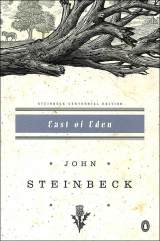
East of Eden

Title: East of Eden
Author: John Steinbeck
Country: America
Year: 1952
Rating: A
Pages: 567 pgs.

First sentence: The Salinas Valley is in Northern California.

To Steinbeck, there was only "one story in the world" (Ch. 34), the story of good and evil. East of Eden is his allegory of that story, and as its title suggests, he believed that story went all the way back to the beginning of mankind. In many ways it parallels the story of Cain and Abel. It is the story of the intertwining of two families, the Trasks and the Hamiltons. The settling and development of the Salinas Valley acts as a third story line, as Steinbeck describes the Valley in rich and vivid descriptions throughout the novel.

I remember that the Gabilan Mountains to the east of the valley were light gay mountains full of sun and loveliness adn a kind of invitation, so that you wanted to climb into their warm foothills almost as you want to climb into the lap of a beloved mother...The Santa Lucias stood up against the sky to the west and kept the valley from the open sea, and they were dark and brooding - unfriendly and dangerous. I always found in myself a dread of west and a love of east. (p.7)

East of Eden is filled with rich, complex characters. Some of my favorites are Samuel Hamilton, an institution in Salinas and the person through which Steinbeck disperses much of his commentary on human nature. Lee, is Adam Trasks' intellectual Chinese-American servant whom uses pidgin English with strangers because they understand him better than when he speaks fluent English. And then there is Cathy [aka Kate]. I believe there are monsters born in the world to human parents. Some you can see, misshapen and horrible...They are accidents and no one's fault, as used to be thought. Once they were considered the visible punishment for concealed sins. And just as there are physical monsters, can there not be mental or psychic monsters born? The face and body may be perfect, but if a twisted gene or malformed egg can produce physical monsters, may not the same process produce a malformed soul? (p. 72) Cathy Ames is the most complex and evil woman in the history of literature (that I have read). She is fascinating and repulsive all at once.

I was first captivated by East of Eden as a teenager, so it was interesting to go back and read the novel after 12 years (as I did with Grapes of Wrath in March). The first time I read the story, everything seemed a little larger than life. The second time around a twinge of tediousness set in here and there, but I was more fully able to understand and appreciate many of the universal themes I skimmed over the first time around. I still consider East of Eden as a masterpiece, standing beside Grapes of Wrath and other novels by Steinbeck.

East of Eden Trivia:
- Steinbeck kept a journal of daily letters to his publisher, that document the writing of his most difficult and personal work. It is now published as Journal of A Novel: The East of Eden Letters.
- Steinbeck acts as both the narrator of the story, and places himself and his family in the novel as minor characters. His mother, Olive Hamilton, is a daughter of Samuel Hamilton. One of the most amusing stories in the novel is the telling of how Olive won a plane ride for selling Liberty Bonds during the war.

This book marks my completion of the Chunkster Challenge. Yay!

Thursday, June 21, 2007

The Bone People

Title: The Bone People
Author: Keri Hulme
Country: New Zealand
Year: 1984
Rating: A-
Pages: 450 pgs.

First sentence: He walks down the street.

The Bone People is a story about an unorthodox trinity between three people. They were nothing more than people, by themselves. Even paired, any pairing, they would have been nothing more than people by themselves. But all together, they have become the heart and muscles and mind of something perilous and new, something strange and growing and great. Together, all together, they are the instruments of change. (p.4) Kerewin Holmes, part Maori and part European, who lives alone in her Tower by the sea; Simon, a confused, turbulent but loving young boy who cannot speak; and Joe Gillayley, his brutal Maori foster parent who loves him, but reverts to brutality because he does not know how to give Simon all that he needs. When their world falls apart, each partakes in their own personal journey towards transformation, redemption and forgiveness.

As she tells the story, Keri Hulme delves into the consciousness of all three characters in a blend of myth, legend, dreams, and a harsh reality. Don't let that first sentence above deceive you. From the very beginning, The Bone People draws you in with its raw emotion and sometimes lyrical, sometimes crude language. There were times I wanted to lay down the book and cry myself to sleep, especially in the last half of the book. Yet at the end, I was left wanting more.Maori culture, while not the focus, influences everything in the novel. The writing is unique and creative, but I do fall into the camp that feels that a little bit of editing would have been useful. Other than that, it was a roller coaster of an experience reading this book.

I have scattered some of my New Zealand photos throughout for the fun of it!
I have watched the river and the sea for a lifetime. I have seen rivers rob soil from the roots of trees until the giants came foundering down. I have watched shores slip and perish, the channels silt and change; what was beach become a swamp and a headland tumble into the sea. An island has eroded in silent pain since my boyhood, and reefs have become islands. Yet the old people used to say, People pass away, but not the land. It remains forever. Maybe that is so. The land changes. The land continues. The sea changes. The sea remains. (p. 336)


I know about me. I am the moon's sister, a tidal child stranded on land. The sea always in my ear, a surf of eternal discontent in my blood. (p.89)

Booking Through Thursday

Since school is out for the summer (in most places, at least), here’s a school-themed question for the week:
Do you have any old school books? Did you keep yours from college? Old textbooks from garage sales? Old workbooks from classes gone by?
I bought very few textbooks for grad school, but I do have a lot of photocopied articles. I kept the undergrad books that I liked, or thought might come in useful. I have a handful of psych books, the anthropology books that I really liked and do actually go back to occasionally, all the english lit novels I enjoyed, and my sign language and spanish books.

How about your old notes, exams, papers? Do you save them? Or have they long since gone to the great Locker-in-the-sky?
I have kept my reports and notes from grad school, and have referred back to them on occasion. I believe I have tossed all of my undergrad stuff, but I have the sneaking suspicion that it's all hiding in a box somewhere in my parent's house. They are definitely pack rats, and I have lost a few things in that mess that will probably only reappear when they decide to pack up their house and retire to the South.

Spring Reading Thing 2007 Wrap-Up

Woot! I finished! Late, late last night I finished reading The Bone People, by Keri Hulme. I will be posting that review later today. But for now, here is my wrap-up post of the Spring Challenge 2007, hosted by Katrina over at Callapidder Days. I really like the format Katrina suggested for the wrap-up post, so I will probably be using a similar format for all of my challenges.

My challenge books were:
Digging to America - Anne Tyler
Purple Hibiscus - Chimamanda Ngozi Adichie
The Bone People - Keri Hulme
I, Rigoberta Menchu - ed. by Elisabeth Burgos-Debray
Red Earth and Pouring Rain - Vikram Chandra

Overall, I read a total of 17 books this spring.

What was the best book you read this spring? My favorite book this spring was one I had picked for this challenge, Purple Hibiscus by Chimamanda Ngozi Adichie. I was struck by the beautiful imagery and lyrical writing; it is a story that will not quickly fade from my memory.

What book could you have done without? I liked all of the books that I picked for the challenge. Out of all the books I read this spring, the only one I could have done without was The Mermaid Chair by Sue Monk Kidd. My least favorite of the challenge books was Digging to America.

Did you try out a new author this spring? If so, which one, and will you be reading that author again? The only new authors amongst my challenge books were Keri Hulme and Vikram Chandra, although I only read Anne Tyler and Chimamanda Adichie for the first time this year. I would like to read more by Keri Hulme, but most of her other work is short stories, which aren't usually my cup of tea. Maybe someday I'll try them out. I will definitely be reading more by Vikram Chandra.

Other new authors this spring include Kiran Desai, Ann-Marie MacDonald, Laura Esquival, Ina May Gaskin, Umberto Eco, and Jennifer Weiner. I liked them all.

If there were books you didn't finish, tell us why. There were no books that I did not finish.

What did you learn -- about anything -- through this challenge? I learned that maybe I should ease up a little on the challenges. I have a feeling I would have enjoyed The Bone People just a little bit more than I did if I didn't put such pressure on myself to finish it by today.

What was the best part of the Spring Reading Thing? Two things: reading great books; and looking at the great books others read.

Would you be interested in participating in another reading challenge this fall? Not this year, as my autumn is going to be pretty chaotic.

Thanks Katrina, for hosting this wonderful challenge!

Wednesday, June 20, 2007

OT: World Refugee Day 2007

Today seems to be the day for my political side to come out.

As some of you know, my career has been working with refugees and asylum seekers, so I always try to take time out in June to participate in a World Refugee Day event. Unfortunately, the events in Baltimore occurred last week, while I was away. Therefore, my small contribution to the day will be this post.

I'd like to share a poem written by an asylum seeker in Australia that was turned into a song for the Scattered People choir. As a member of the choir along with numerous refugees, it is a song that continues to bring tears to my eyes. You can hear a sample of the song here. And if you would by chance be interested in buying the Scattered People CD, just let me know. :)

If you feel so inclined, check out a book about refugees. Human Cargo by Caroline Moorehead comes highly recommended; That State of the World's Refugees published by the UNHCR; or The Middle of Everywhere: Helping Refugees Enter the American Community by Mary Pipher. The website of the UNHCR has lots of accessible information.

You can also check out this article about Iraqi refugees on CNN. It's the first I have seen an American media outlet highlight Iraqi refugees. America is also finally starting to accept some Iraqi refugees for resettlement. Progress is being made.

Don't forget, that a refugees journey does not end when if they are resettled in another country. Resettlement non-profit organizations are always in need of help and assistance in their struggle to meet the needs of refugees. Find one in your community today!

Hometown
We belong
Never lonely we belong
Safe and warm this is our hometown
We belong


My hometown

How I love the summer

Lotus plants and buffalo

We are fishing, sw
imming
This is life

In my hometown


My hometown

Working with my hands

And I feel proud of what I do

I support my family

This is life
In my hometown

We belong

Never lonely we belong

Safe and warm this is our hometown

We belong


My hometown

Work the land till harvest

Feel the sweat then celebrate

Let the seasons turn

For this life in my hometown


My hometown

How I yearn to be there

Lotus plants and buffalo
Lay me down there someday
Let me sleep

In my hometown

Salman Rushdie's knighthood

While listening to NPR's 'Talk of the Nation' yesterday, I was somewhat surprised to hear about the re-ignited furor over Salman Rushdie and his most infamous work, The Satanic Verses, sparked this weekend when Rushdie was awarded a knighthood by the Queen of England.

First of all, it amazes me that this 20-year controversy still has the power to move people enough to demonstrate and call (once again) for Rushdie to be killed. Or to wonder if it is all a well-planned action by religio-political groups? Muslim leaders in many nations have also voiced their outrage over his knighthood. The Pakistani Religious Affairs Cabinent minister was reported in The Independent as saying that,

"if someone exploded a bomb on his [Salman Rushdie's] body he would be right to do so".

For those who have not read the book, the furor basically goes back to a series of dreams that one of the characters, Gabreel, has. The story begins as Gabreel and Saladin fall through the air, victims of a terrorist bombing of an airplane. Over time, Gabreel, who has doubts about religion, dabbling in Christianity and Judaism as well as Islam, develops a halo and the appearance of the angel Gabriel (this is the angel that appeared to Muhammad in a cave on Mt Hira). Saladin grows horns and a tail, beginning to look like Satan. Gabriel's dreams involve a false prophet named Mahound, and here begins the basis for the much of the alleged blasphemy. Mahound is historically a derogatory name for Muhammad.

'Mahound the businessman, climbing his hot mountain in the Hijaz.
The mirage of a city shines below him in the sun.'
(Satanic verses, pg 93)

Furthermore, Gabreel's dreams show prostitutes taking the names of Muhammad's wives, to attract Muslims.

Rushdie, himself raised in the Islamic faith, has apologized to any Muslims who took offence. He has repeatedly said it was not his intention to criticize those who practice Islam, but to write a fictional story about one person's doubts. It is also interesting to note that the story was also largeley a critique on the Thatcher government. Yet, the British government has spend oodles of money in providing safe houses and other protection to Rushdie, and has now deemed to honor him with a knighthood. Huh.

That little human right known as freedom of speech seems to be getting a beating this year, particularly where religious issues are concerned. The 'chocolate Jesus' controversy that occurred around Easter, leading to the cancellation of an exhibit that included a chocolate sculpture of a nude, anatomically correct Jesus pops to mind.

I will hand it to the Guardian to give the understatement of the day,
'Rushdie was celebrating his 60th birthday in London yesterday and is not commenting on the latest threats to his life. It is understood he is anxious not to inflame the situation.'